


Quick Overview: Choose Your US Sales Channel by Who Brings in Buyers and How Duties Get Paid
Sales channels for cross-border ecommerce to the US fall into two broad groups: marketplaces such as Amazon.com, eBay, and Etsy, and your own online store. Marketplaces let you sell where buyers already gather, but roughly 10-20% of each sale goes to fees. Your own store keeps fees lower, but you have to bring in buyers yourself.
Duties and shipping matter just as much as the channel.
- End of the de minimis exemption: Since August 29, 2025, the US no longer waives duties on shipments worth $800 or less. A law also repeals the exemption permanently on July 1, 2027
- Duties on goods from Japan: Since July 24, 2026, items with a general (MFN) duty rate below 12.5% face a combined rate of 12.5% once the additional duty is included
- Japan Post advance declaration: Mail containing goods worth $2,500 or less must be declared in advance, with duties prepaid, through a certified provider's app
This article draws on official company pages, U.S. Customs and Border Protection (CBP) rules, and information from Japan Post and JETRO to explain how the channels differ and what to watch for on duties and shipping. All information is as of November 27, 2026.
The Main Sales Channels for Selling to the US
There are four main channels for selling from Japan to US customers.
| Channel | Best suited for |
|---|---|
| Amazon.com | Everyday goods and electronics that shoppers search for and compare. Sellers who want to expand across North America from one dashboard |
| eBay | One-of-a-kind, pre-owned, and collectible items |
| Etsy | Handmade goods, vintage items, and craft supplies |
| Your own store (Shopify, Leap, etc.) | Products that rely on a brand story. Sellers who want to build repeat customers or business accounts |
Walmart Marketplace also accepts applications from sellers outside the US. However, it requires fulfillment through Walmart Fulfillment Services (WFS) or another US warehouse that can handle returns, so it is hard to use if you plan to ship directly from Japan.
US Sales Channel Comparison Table (as of November 2026)
The table compares the main channels on pricing, fees, cross-border support, marketing features, and B2B support. As an own-store option, it also includes Leap, a cross-border ecommerce tool that lets AI handle marketing too. All amounts and rates were checked on each company's official pages as of November 2026.
| Amazon.com | eBay (ebay.com) | Etsy | Leap (own store) | |
|---|---|---|---|---|
| Pricing (fixed costs) | Professional: $39.99/month; Individual: $0.99 per item sold | 250 free listings per month, then $0.35 per listing | $0.20 per listing | From ¥0/month (excl. tax) |
| Fees per sale | Varies by category (15% in many categories) | 13.6% + $0.40 per order in most categories, plus a 1.35% international fee | 6.5% transaction fee + 6.0% + $0.30 payment processing (Japanese bank account) | 6% of sales (includes card processing) |
| Cross-border support (language, currency, payments) | Seller Central can be used in Japanese, with Japanese-language support. Payments handled by Amazon | 3.0% currency conversion fee when listing and payout currencies differ | Payments handled by Etsy Payments, with payouts to a Japanese bank account | Multilingual; USD/EUR/JPY; Visa/Mastercard |
| Marketing features | Ads such as Sponsored Products | Ads such as Promoted Listings | Etsy search and ads. Orders from Etsy's Offsite Ads carry a 12-15% fee | Automated blog creation (SEO/AIO), email newsletters, CRM |
| B2B support | Business pricing and quantity discounts via Amazon Business (Professional plan) | No dedicated feature found in official materials | No dedicated feature found in official materials | B2B cart (company-specific pricing, quote requests) |
Marketplace fees can be thought of as including the cost of bringing buyers to you. Leap has lower fees, but it does not come with a built-in crowd of shoppers the way a marketplace does, and it offers less design and feature customization than Shopify and similar platforms.
Selling on Amazon.com
Amazon.com lets you list products where US shoppers search and compare. Amazon Japan's global selling page says Seller Central (the seller dashboard) can generally be used in Japanese, and that in-account support is available in Japanese.
- Pricing: Professional is $39.99/month plus selling fees; Individual is $0.99 per item sold plus selling fees
- Referral fees: Vary by category, with a $0.30 minimum per item in most categories. Media items such as books and DVDs carry an additional $1.80 closing fee per item
- Unified North America account: One account covers Amazon in the US, Canada, Mexico, and Brazil
- Logistics: With Fulfillment by Amazon (FBA), Amazon handles storage and delivery
If you use FBA, you send inventory to Amazon warehouses in the US, which means import procedures and duty payments happen at that point. That changes when you pay duties compared with shipping each order from Japan.
Selling on eBay
eBay makes it easier to reach buyers worldwide for one-of-a-kind, pre-owned, and collectible items. Fees on ebay.com as of November 2026 are as follows.
- Insertion fees: Up to 250 listings per month free, then $0.35 per listing
- Final value fees: In most categories, 13.6% on the portion up to $7,500 per item and 2.35% above that, plus $0.40 per order ($0.30 for orders of $10 or less)
- International fee: 1.35% of the sale total when a seller registered in Japan sells to a US buyer
- Currency conversion fee: 3.0% for sellers in Japan when listing and payout currencies differ. eBay says this fee will increase from December 2, 2026
Selling on Etsy
Etsy is a marketplace where buyers look for handmade and vintage goods. For sellers who receive payouts to a Japanese bank account, fees are as follows.
- Listing fee: $0.20 per listing (charged whether or not the item sells)
- Transaction fee: 6.5% of the order total, including any shipping or gift-wrap charges
- Payment processing fee: 6.0% + $0.30 per order
- Offsite Ads fee: When an order comes through Etsy's Offsite Ads, 15% of the order total if you made less than $10,000 in the past 365 days (12% at $10,000 or more), capped at $100 per order
Selling Through Your Own Online Store
Your own store is a channel where you bring US buyers to your own website. There are no marketplace referral fees, and you own your customer data, which makes it easier to drive repeat sales through email and build ongoing business accounts.
The two main approaches are using a cart platform such as Shopify or using a tool built for cross-border ecommerce. Shopify's Basic plan costs ¥4,850 per month on monthly billing in Japan, and the Shopify Payments fee for international cards is 3.9% (as of November 2026). Its strength is the wide range of design options and app-based extensions.
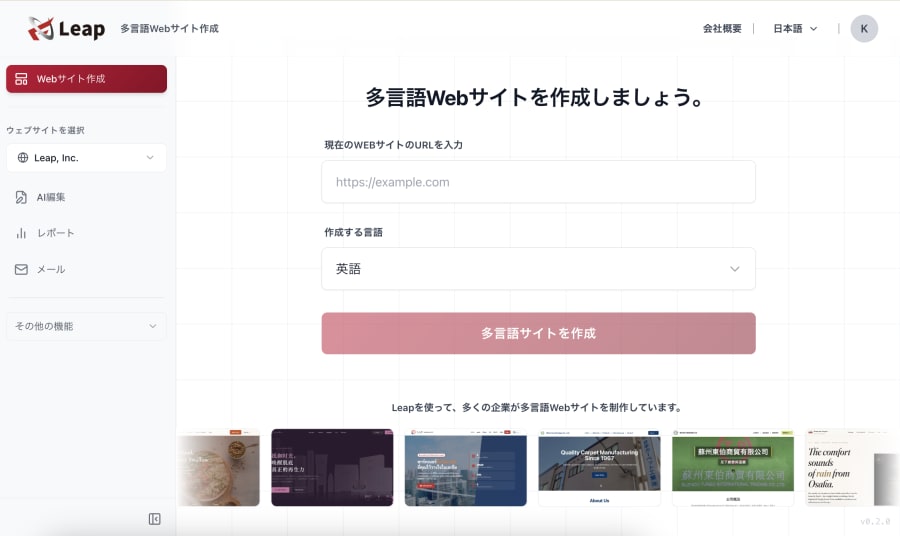
Leap, a cross-border ecommerce tool that lets AI handle marketing too, supports 22 major countries including the US, displays prices in US dollars, and lets you create blog posts and send newsletters by chat. You can set sales countries for each product, so items you cannot ship to the US are hidden from US shoppers.
US Tariffs: What the End of the De Minimis Exemption Means
De minimis was the US exemption that waived duties on shipments worth $800 or less. The US suspended it for all countries on August 29, 2025, and made the suspension indefinite through regulations in 2026. Even small parcels now require duty payment and import procedures.
| Date | What happened |
|---|---|
| July 4, 2025 | The One Big Beautiful Bill Act became law, repealing de minimis effective July 1, 2027 |
| August 29, 2025 | Executive Order 14324 suspended de minimis for shipments from all countries |
| February 20, 2026 | Executive Order 14388 continued the suspension, including for mail |
| June 24, 2026 | CBP published and put into effect a rule indefinitely suspending de minimis for shipments arriving by modes other than mail (such as express couriers) |
| July 24, 2026 | The indefinite suspension for mail and a new postal informal entry process took effect |
Duties on Goods from Japan (as of November 2026)
Since July 24, 2026, goods from Japan have been subject to additional Section 301 duties set by the Office of the U.S. Trade Representative (USTR). According to JETRO, they work as follows for Japan.
- Items with a general duty rate below 12.5%: the general rate and the additional rate combined come to 12.5%
- Items with a general duty rate of 12.5% or more: the additional rate is zero
- Items subject to Section 232 duties, among others, are excluded
On November 25, 2026, USTR also proposed additional duties on several economies, including Japan, based on a separate Section 301 investigation. Japan falls in the 15% group, and a decision will follow public comments and a hearing scheduled for January 25, 2027. Because duties have changed many times in a short period, check the latest information before you ship.
What to Watch for When Shipping to the US
You can ship to the US through Japan Post, an international express courier, or a US warehouse. Duties apply whichever you choose, so decide in advance who pays them and when.
Shipping with Japan Post
Japan Post stopped accepting goods for sale bound for the US on August 27, 2025, resumed at designated post offices on April 14, 2026, and expanded acceptance to nearly all post offices on October 15, 2026. For goods worth $2,500 or less, the following steps are required.
- Declare the shipment in advance through an app from a certified provider recommended by Japan Post (Zonos or SafePackage)
- Prepay the duty shown in the app (the provider's own fees also apply)
- Attach a label showing "DDP-" and a 13-digit declaration number, then hand in the parcel
If an item is valued at more than ¥200,000, a separate Japanese export declaration is also required.
Shipping with an International Express Courier
You can also ship with international express couriers such as DHL and FedEx, or with Japan Post's international express service UGX. UGX supports both sender-paid and recipient-paid duties. For a comparison of carriers, see "Overseas Carrier Comparison for Cross-Border Ecommerce."
Rules for Food, Cosmetics, and Similar Products
Japan Post's UGX page notes that items regulated by the US Consumer Product Safety Commission (CPSC), and foods, teas, supplements, and cosmetics regulated by the Food and Drug Administration (FDA), require advance procedures. Whatever channel you use, confirm whether your product is regulated before you list it.
Cost Estimate: Selling a $50 Item to a US Customer
Using official pricing, we estimated the channel fees and duties when a single $50 item sells (our own estimate; shipping and exchange rates not included). The duty assumes an item with a general duty rate below 12.5%.
| Channel | Assumptions | Channel fees | Duty (12.5%) |
|---|---|---|---|
| Amazon.com | 15% referral fee category, Professional plan | $7.50 (plus $39.99/month) | $6.25 |
| eBay | 13.6% final value fee, within free listing allowance | $6.80 + $0.40 + $0.675 = about $7.88 | $6.25 |
| Etsy | No shipping charge, no Offsite Ads | $0.20 + $3.25 + $3.30 = $6.75 | $6.25 |
| Leap | 6% of sales | $3.00 (plus monthly plan) | $6.25 |
For a $50 item, duty alone comes to $6.25, roughly as much as the channel fees. Under de minimis, that $6.25 did not apply. The lower the price, the larger the share duties take, so consider pricing that encourages larger orders or showing duty-inclusive prices.
How to Choose a Sales Channel for the US
Working through the following steps makes it easier to choose a channel for the US.
- Check whether your product is regulated: If it falls under FDA or CPSC rules, confirm the required procedures before choosing a channel
- Build duties and shipping into your price: As the estimate shows, duties can cost as much as channel fees
- Decide who brings in buyers: If you lack marketing resources, start with a marketplace. If you want to grow a brand and repeat customers, build your own store
- Decide how to ship: Choose between shipping each order from Japan and holding inventory in FBA or a US warehouse
Recommendations by situation:
- If you want to test whether searchable products sell, try Amazon.com
- For one-of-a-kind or collectible items, try eBay
- For handmade or vintage goods, try Etsy
- If you want detailed control over design and features, consider Shopify
- If you want overseas marketing (SEO, email) handled together and also want to sell to business buyers, consider Leap
You can also build your own store after seeing which products perform well on marketplaces. For a closer look at how marketplaces differ, see "Cross-Border Ecommerce Marketplace Comparison."
FAQ
Q. Do I have to pay duties when selling from Japan to the US?
A. Yes. Since August 29, 2025, the US no longer waives duties on shipments worth $800 or less (de minimis), so even small parcels require duty payment. For goods from Japan, items with a general duty rate below 12.5% face a combined rate of 12.5% with the additional duty (as of November 2026).
Q. How long will the de minimis suspension last?
A. It has no end date. CBP made the suspension indefinite through 2026 regulations, and a law repeals de minimis on July 1, 2027.
Q. Can I ship products to the US with Japan Post?
A. Yes. Since October 15, 2026, nearly all post offices accept US-bound mail, but goods worth $2,500 or less must be declared in advance, with duties prepaid, through the Zonos or SafePackage app.
Q. Which is better for selling to the US, Amazon or eBay?
A. It mainly depends on your product. Everyday goods that shoppers search for and compare suit Amazon.com, while one-of-a-kind, pre-owned, and collectible items suit eBay. On fees, Amazon.com in a 15% referral fee category and eBay in a 13.6% final value fee category (including the international fee) both come to roughly 15% of sales (as of November 2026).
Summary and Key Takeaway
For cross-border ecommerce to the US, choose among marketplaces such as Amazon.com, eBay, and Etsy and your own online store, based on your products and your capacity to bring in buyers.
The comparison shows that for the US, how you pay duties now affects profit as much as where you sell. With de minimis gone, even a $50 item carries duties roughly equal to the channel fees. Deciding whether buyers pay duties on delivery or you prepay and build them into the price, and explaining that on your product pages, helps prevent returns and refused deliveries. US duty rules have changed many times since 2025, so plan to review your setup regularly even after choosing a channel.
Leap is a cross-border ecommerce tool that lets AI handle marketing too. Just chat with it to build a multilingual, multi-currency online store and run overseas marketing such as SEO and email newsletters.
References
- Indefinite Suspension of the De Minimis Exemption for Mail Shipments and New Postal Informal Entry Process (June 24, 2026) - Federal Register
- Indefinite Suspension of the De Minimis Exemption for Merchandise Arriving Through All Modes Other Than the International Postal Network (June 24, 2026) - Federal Register
- USTR finalizes Section 301 duties on 60 economies including Japan over forced labor import bans (July 24, 2026) - JETRO (Japanese)
- USTR releases Section 301 overcapacity findings and proposes 15-35% additional duties (November 26, 2026) - JETRO (Japanese)
- Expansion of acceptance of US-bound mail (October 14, 2026) - Japan Post (Japanese)
- Follow-up: Resumption of acceptance of US-bound mail - Japan Post (Japanese)
- Temporary suspension of US-bound mail due to US tariff and regulatory changes (August 25, 2025) - Japan Post (Japanese)
- UGX (Yu Global Express) - Japan Post (Japanese)
- Amazon Global Selling - Amazon Seller Services Japan (Japanese)
- How much does it cost to sell on Amazon? - Sell on Amazon
- Amazon Business - Sell on Amazon
- Amazon Ads - Sell on Amazon
- Selling fees - eBay Customer Service
- International fees for eBay global sellers - eBay
- eBay Advertising - eBay Seller Center
- What are the Fees and Taxes for Selling on Etsy? - Etsy Help
- What are Payment Processing Fees for Selling on Etsy? - Etsy Help
- Seller registration guide - Walmart Marketplace
- Pricing - Shopify Japan (Japanese)
- Pricing - Leap