


Quick Overview: What Sells Best in Cross-Border Ecommerce
The Japanese products that sell best through cross-border ecommerce are toys and hobby goods, trading cards, figures, fashion and wristwatches — in other words, products that are hard to get outside Japan and products valued for Japanese quality.
- Market size: Japan's Ministry of Economy, Trade and Industry (METI) estimates that in 2025, consumers in China bought ¥2.756 trillion worth of goods from Japanese businesses through cross-border ecommerce, and consumers in the US bought ¥1.6527 trillion
- Most popular by number of purchases: In H1 2026 data from Buyee, an overseas shopping service, the top three were toys, hobby & goods; trading cards; and fashion
- Most popular by sales value: In ZenMarket proxy-shopping data from July 2025 to June 2026, the top three were figures, trading cards and wristwatches
- B2B (wholesale to overseas retailers): In the 2025 ranking from wholesale marketplace SD export, tableware and writing instruments ranked high in many countries, and plush toys were bestsellers across markets
- How to choose: Don't just match your products to popular categories. Check whether you can ship them, what the final price looks like with shipping and duties, and how each country responds before narrowing down
This article uses only sourced survey data to explain the most popular product categories in cross-border ecommerce and how to find out whether your own products will sell overseas. Information is current as of November 27, 2026.
How Big Is the Cross-Border Ecommerce Market?
Sales from Japan to China and the US alone exceed ¥4 trillion a year. METI's FY2025 Market Survey on Electronic Commerce (published October 2026) estimates cross-border ecommerce among Japan, the US and China in 2025 as follows.
| Consumers in | Purchases from Japanese businesses (2025) |
|---|---|
| China | ¥2.756 trillion |
| US | ¥1.6527 trillion |
The same survey cites a private-sector estimate that put the global cross-border ecommerce market at US$1.24 trillion in 2025. It also notes that consumers commonly shop cross-border because they want products or limited editions they can't buy at home, because of price advantages, and because they trust the quality of foreign products and manufacturers. These three reasons line up closely with the traits of bestselling products covered later in this article.
Popular Product Categories in Cross-Border Ecommerce
According to survey data, the most popular categories are toys and hobby goods, trading cards, anime and manga goods, fashion and wristwatches. Each dataset uses a different source, period and metric (number of purchases vs. sales value), so we look at them one by one.
Popular Categories by Number of Purchases (Buyee)
Purchase data from Buyee, an overseas shopping service run by BEENOS Inc., shows toys, hobby goods and trading cards at the top. The H1 2026 figures combine purchases of new items (primary market) and used items (secondary market).
| Rank | 2025 (full year) | H1 2026 (Jan–Jun) |
|---|---|---|
| 1 | Trading cards | Toys, hobby & goods |
| 2 | Toys, hobby & goods | Trading cards |
| 3 | Anime & manga goods | Fashion |
| 4 | Fashion | – |
| 5 | Celebrity merchandise | – |
Key trends in H1 2026:
- Toys, hobby & goods: Purchases grew 91.4%. Beyblade purchases rose more than sixfold year over year, and fan merchandise such as acrylic stands and pin badges grew more than 100% in East Asia and Europe
- Trading cards: Pokémon cards and K-pop cards together made up more than 40% of the category, and ONE PIECE cards grew more than 300%
- Fashion: Apparel accounted for 71.0% of the category, with shirts and blouses, and T-shirts and tops, growing the most
- Books & magazines: Manga and comics grew more than 50%
BEENOS named "fan collector spending" as the cross-border ecommerce keyword for 2025. Shoppers are increasingly picking and collecting specific items tied to the series and celebrities they love.
Popular Products by Sales Value (ZenMarket)
Data from ZenMarket, a proxy-shopping service run by ZenGroup Inc., covering July 2025 to June 2026, lists the top 10 products by sales value as follows.
| Rank | Product | Average price |
|---|---|---|
| 1 | Figures | ¥7,192 |
| 2 | Trading and collectible cards | ¥7,611 |
| 3 | Wristwatches | ¥20,909 |
| 4 | Electric guitars | ¥89,284 |
| 5 | Game consoles | ¥11,179 |
| 6 | Video games | ¥4,379 |
| 7 | Toys | ¥6,703 |
| 8 | Plush toys | ¥4,251 |
| 9 | Fishing rods | ¥26,424 |
| 10 | Handbags | ¥20,845 |
Compared with rankings by number of purchases, higher-priced hobby gear such as wristwatches, electric guitars and fishing rods stands out.
Popular Products in B2B (SD export)
In the 2025 B2B cross-border ecommerce ranking from SD export, a B2B wholesale marketplace run by Raccoon Commerce Inc., tableware and writing instruments again ranked high in many countries. In 2025, plush toys became bestsellers across markets, craft yarn and knitting wool grew 52.4% year over year, and tea ware orders rose 2.2 times in one year. SD export named matcha, stamps, and ethical and sustainable products as the categories to watch in 2026.
Do Cosmetics and Food Sell Well Cross-Border?
Cosmetics and food attract plenty of interest as Japanese products, but they don't appear among the top categories in the three purchase datasets used in this article. That said, SD export lists matcha as a category to watch in 2026, and its tea ware orders have grown sharply. Cosmetics and food are subject to many country-specific ingredient rules, import restrictions and shipping limits, so before asking whether they will sell, you need to confirm whether you can ship them to that country at all.
What Sells Differs by Country and Region
What sells in cross-border ecommerce varies by country and region. In Buyee's H1 2026 data, toys, hobby & goods, trading cards and fashion all made the top three in North America, East Asia, Europe and Southeast Asia.
There were also clear regional differences:
- Middle East: Accessories and watches ranked first, ahead of toys and trading cards. Car and motorcycle parts made the top five only in this region
- Latin America: Fashion entered the growth ranking for the first time, growing more than 70%. Japan-exclusive sneakers, streetwear, Japanese watches and anime collaboration products were popular
- East Asia and Southeast Asia: The main female users were in their 40s in East Asia and in their 30s in Southeast Asia, older than in other regions
The same product can get a very different response depending on the target country. Treat popular-category data as a global average, and decide where to sell by testing your own products.
What Bestselling Cross-Border Products Have in Common
The survey data points to three traits shared by products that sell well cross-border.
- Hard to get outside Japan: Japan-only trading cards, anime and celebrity merchandise, Japan-exclusive sneakers and so on. This matches the "products or limited editions you can't buy at home" motive that METI's survey identifies
- Fun to collect: Figures, plush toys, acrylic stands and other products people want to collect as a series. This is what BEENOS calls "fan collector spending"
- Valued for Japanese quality and functionality: Writing instruments, tableware, wristwatches, fishing rods and so on. SD export notes that uniquely Japanese features, such as erasable ballpoint pens and multi-function pens, are highly valued
If your product fits one of these three traits, it has a good chance of selling cross-border. Even if it doesn't, a useful test is whether you can explain why someone overseas would go out of their way to buy it from Japan.
How to Choose Products to Sell Internationally
Following these five steps helps you avoid spending time and money on products that won't sell.
- Match your products to popular categories and the three traits: Put into words why overseas buyers would choose them
- Check whether you can ship and sell them: Review Japan Post's list of items that cannot be sent by international mail and the prohibited items for each target country
- Estimate the price including shipping and duties: Check whether the total an overseas buyer pays is reasonable compared with similar products available locally
- Measure interest by country: Publish product pages in multiple languages and see which countries send traffic (explained in the next section)
- Start selling in the countries that respond best: Decide your sales countries, shipping methods and languages based on where traffic and inquiries come from
Check Shipping Restrictions and Country-Specific Rules
Japan Post lists aerosol cans, perfume, nail polish, power banks and e-cigarettes as typical examples of items that cannot be sent by international mail. Sunscreen, hair tonic and alcoholic beverages also cannot be sent if their alcohol content exceeds 24%. In addition, some items, such as alcohol, tobacco, meat, vegetables and fruit, are banned by the import rules of the destination country, and in some countries this includes cup noodles, curry and consommé that contain beef.
METI's survey also notes that in 2025 the US, Europe and other markets abolished or revised their tax exemptions for low-value imports one after another. Even if you pick a popular category, the final price depends on the tax and shipping conditions of each sales country, so check them while you choose products. For a comparison of shipping options, see "Overseas Carrier Comparison: DHL, FedEx and EMS."
How to Find Out Where Your Products Will Sell with Country-Level Analytics
Country-level analytics is a market research method that looks at how many visitors your site gets from each country to find the markets most interested in your products. Popular-category rankings only show global trends, but country-level traffic tells you which countries are interested in your own products.
Here is how to do it:
- Create pages introducing the products you want to sell in English and other languages
- Make sure people overseas can find the pages through social media, blogs and search
- Compare visits by country over a set period
- Prepare to sell in the countries with the most visits, adapting language, currency and shipping
The advantage of this method is that you can test demand at low cost before shipping inventory overseas or listing on marketplaces. For example, Buyee's data showed watches growing in the Middle East and fashion in Latin America, but you won't know whether your own watches or clothing attract interest there until you look at the traffic.
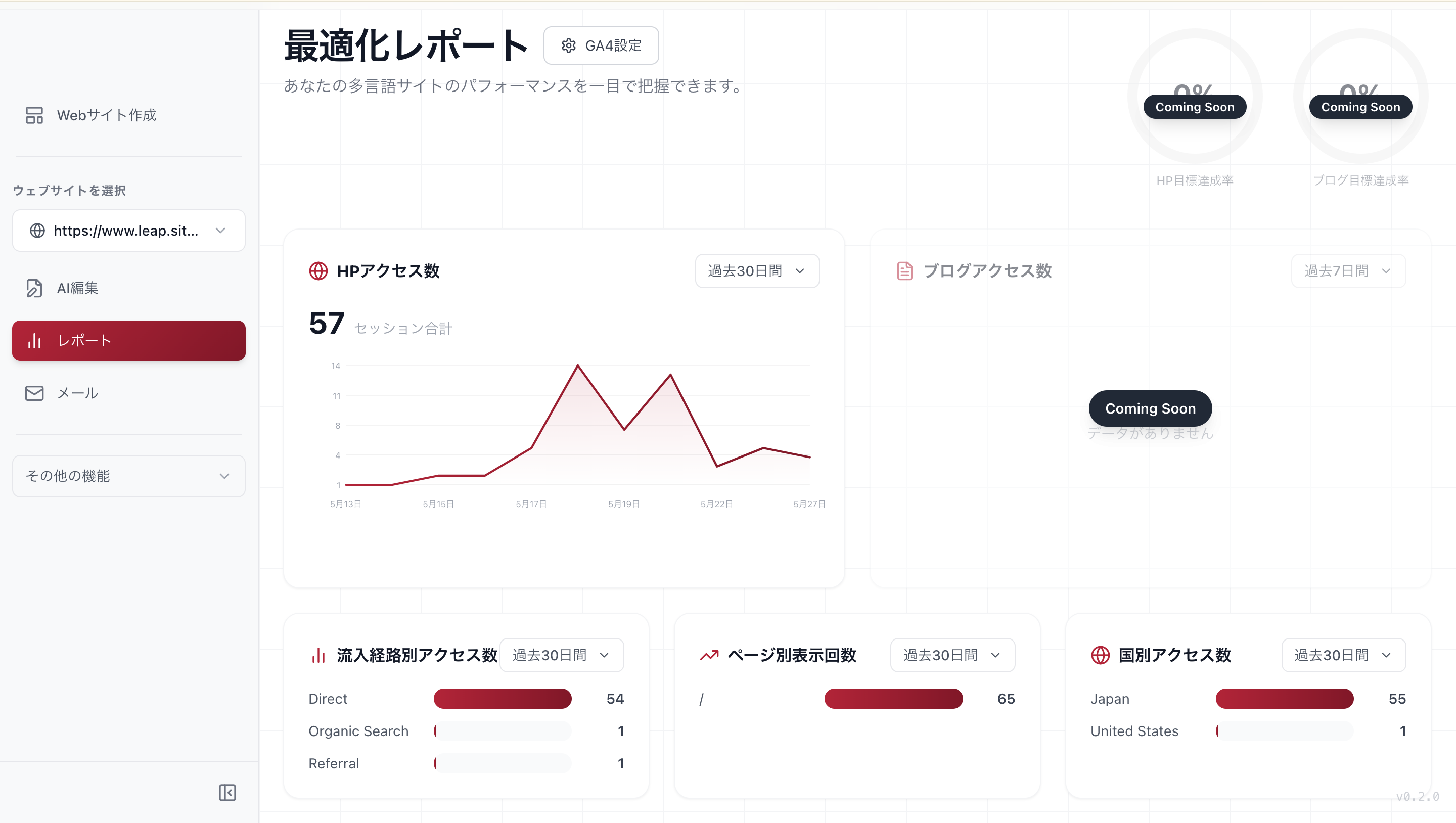
Leap, a cross-border ecommerce tool that lets AI handle marketing too, also includes an analytics feature that shows visits by country, which you can use for country-by-country test marketing.
FAQ
Q. What sells best in cross-border ecommerce?
A. It depends on the survey, but toys and hobby goods and trading cards consistently rank at the top. By number of Buyee purchases, trading cards ranked first in 2025 and toys, hobby & goods ranked first in H1 2026, while figures ranked first by ZenMarket sales value.
Q. Do used items sell in cross-border ecommerce?
A. Yes. Buyee's H1 2026 ranking combines purchases of new items (primary market) and used items (secondary market), and toys, hobby & goods and trading cards rank at the top of it.
Q. Do food and cosmetics sell in cross-border ecommerce?
A. They attract interest, but you can't sell them until you've checked each country's regulations. Japan Post gives meat, vegetables, fruit and alcohol as examples of items that may be banned by destination-country rules, and cosmetics and beverages with more than 24% alcohol cannot be sent by international mail.
Q. How can I find out whether my products will sell overseas?
A. An easy way is to publish product pages in multiple languages and compare visits by country. Once you know which countries bring traffic and inquiries, you can narrow down your sales countries, languages and shipping methods.
Summary and Key Takeaway
The products that sell well cross-border, including toys and hobby goods, trading cards, figures, fashion and wristwatches, share at least one of three traits: they are hard to get outside Japan, they are fun to collect, or they are valued for Japanese quality. In B2B, practical Japanese products such as tableware and writing instruments are also chosen in many countries.
But rankings are only a global average. Even within the same category, watches are growing in the Middle East and fashion in Latin America, so the best countries differ by product. What matters more than selling a popular category is using data to confirm where, and why, your products are chosen. Form a hypothesis from the rankings, confirm you can ship, then check the response with country-level traffic. Following this order lets you find the right products and the right countries at low cost.
Leap is a cross-border ecommerce tool that lets AI handle marketing too. Just chat with it to build a multilingual, multi-currency online store and run overseas marketing such as SEO and email newsletters.
References
- FY2025 Market Survey on Electronic Commerce, Report (October 2026) - Ministry of Economy, Trade and Industry (Japanese)
- Results of the FY2025 Market Survey on Electronic Commerce - Ministry of Economy, Trade and Industry (Japanese)
- BEENOS announces "Cross-Border EC × H1 2026 Trends" (August 27, 2026) - PR TIMES (Japanese)
- BEENOS announces "Cross-Border EC × Hit Ranking 2025" (February 27, 2026) - PR TIMES (Japanese)
- Top 100 Japanese Products That Sell in Cross-Border Ecommerce (2026) - Cross-Border EC Journal, ZenGroup (Japanese)
- SD export announces 2025 B2B cross-border ecommerce ranking (November 12, 2025) - PR TIMES (Japanese)
- Items That Cannot Be Sent by International Mail - Japan Post (Japanese)