

Quick Overview: Pick the Type of Platform First, Then Compare
The fastest way to choose a cross-border ecommerce platform is to first decide which of four types fits your business — an online store builder, a domestic cart with cross-border add-ons, a proxy service added to your existing site, or a global marketplace — and only then compare prices and features. The type determines how you pay (a monthly fee or a percentage of sales), how deep the multi-language and multi-currency support goes, and who is responsible for bringing in customers.
This guide is written for small and mid-sized businesses in Japan that want to start selling internationally. It compares Shopify, ZenLink, Amazon Global Selling, and Leap on five criteria: pricing, fees, cross-border support, marketing tools, and B2B features. All figures were checked on each company's official website as of November 2026. We also estimate monthly costs at different sales levels and suggest which platform suits which situation.
What Is a Cross-Border Ecommerce Platform?
A cross-border ecommerce platform is a system for selling products online to consumers or businesses in other countries, such as a tool for building your own online store or a marketplace where you can list products.
Compared with selling domestically, cross-border ecommerce adds several tasks: showing product pages in other languages, displaying prices in local currencies, accepting the payment methods people use in each market, and shipping overseas. The biggest difference between platforms is how much of this they handle out of the box, and how much you have to cover yourself or with outside services.
The Four Types of Cross-Border Ecommerce Platforms
Cross-border ecommerce platforms fall into four broad types. Most comparison articles split them into just two, "your own store" and "marketplaces," but this guide uses four categories to reflect the options small and mid-sized businesses actually choose between.
1. Online Store Builders (Shopify, Leap, etc.)
An online store builder is a tool for creating and running an international online store on your own domain. It makes it easy to express your brand and lets you own your customer data, but you are generally responsible for driving traffic yourself.
2. Domestic Carts With Cross-Border Add-Ons (BASE, STORES, etc.)
This type takes a domestic online store service and adds overseas sales features or integrations with outside services. If you already run a store in Japan, it is an easy way to test international sales without much extra work. For a detailed look at how domestic carts differ in their cross-border features, see "4 Major Cart Platforms Compared (BASE/STORES/Color Me Shop/Shopify): Cross-Border Readiness."
3. Proxy Services Added to Your Existing Site (ZenLink, etc.)
A proxy service lets you add a tag or similar code to your existing domestic online store and hand off overseas order taking, payment, international shipping, and customer inquiries to an outside company. You can start without building a foreign-language site, but the proxy company handles most of the interaction with overseas customers.
4. Global Marketplaces (Amazon, eBay, etc.)
Selling on a global marketplace means listing your products on a major overseas ecommerce marketplace. Because the marketplace already draws shoppers, you can get sales opportunities even before your brand is known. On the other hand, you pay selling fees, face price competition within the marketplace, and have limited control over how your brand is presented.
How to Choose a Cross-Border Ecommerce Platform: 5 Key Factors
Comparing platforms on these five factors makes it much easier to find the right fit.
- Coverage of your target countries and regions: Check whether the platform supports shipping to your target countries, their local currencies, and the payment methods people use there.
- Cost structure: Whether costs are mainly a fixed monthly fee or a percentage of sales determines which option is cheaper at your sales volume.
- Depth of multi-language, multi-currency, and payment support: Check whether translation is built in or requires apps or outside services.
- Who drives traffic: Will you rely on a marketplace's audience, run SEO (search engine optimization) and email newsletters yourself, or get help from the tool or a proxy company?
- B2B support: If you want to sell wholesale to overseas buyers or distributors, check whether the platform supports company-specific pricing and invoice payment.
Top-ranking comparison articles also point to Japanese-language support and whether you have staff who can run the store as factors to consider.
Cross-Border Ecommerce Platform Comparison Table (as of November 2026)
Here is how the main cross-border ecommerce platforms compare on the five criteria. Prices and features are based on each company's official website as of November 2026.
| Criteria | Shopify | ZenLink | Amazon Global Selling | Leap |
|---|---|---|---|---|
| Type | Online store builder | Proxy service added to your existing site | Global marketplace | Online store builder |
| Pricing | Monthly billing: Basic from ¥4,850/month; annual billing: Basic from ¥3,650/month | No setup fee, no monthly fee | Professional plan: $39.99/month (Amazon.com). For unified accounts across multiple countries, the lower of the sum of each country's fee or the equivalent of $39.99 | Free plan ¥0; Starter from ¥9,800/month (excl. tax) |
| Fees | Shopify Payments international cards: 3.9% (Basic) and down. Third-party payment providers: 2% transaction fee (Basic) and down | 10% of monthly sales (service fee) | Referral fees vary by category; 8–15% for most categories | 6% of sales (includes credit card processing fees) |
| Languages | Storefront translation (all plans) | 19 languages (handled by ZenMarket) | Seller Central can be operated in Japanese | 1–10 languages depending on plan (unlimited on Enterprise) |
| Currencies and payments | Local currency pricing and local payment methods require Shopify Payments | 150 payment methods; ships to 175 countries and regions | Supports transactions in different currencies | USD, EUR, and JPY; 22 major countries. Visa and Mastercard (bank transfer and invoice payment also available for B2B) |
| Marketing tools | Email campaigns, customer segments, marketing automation (all plans) | Logo placement in ZenMarket's recommended section, feature articles, translated landing pages, etc. (included in the service fee) | List products in front of the marketplace's shoppers | Multilingual email newsletters, CRM, localization suggestions, AI-written multilingual blog posts (SEO/AIO; Basic plan and up) |
| B2B support | B2B features (up to 3 catalogs on Basic, Grow, and Advanced; unlimited on Plus) | Not stated on the official page | B2B selling through Amazon Business on the Professional plan | Dedicated B2B cart (company-specific pricing, volume discounts, quote requests) |
| Customization | High (extend functionality with apps) | Keep your existing site as is | Follow the marketplace's format | Mostly templates and editing via AI chat; not built for fine-grained custom development |
The figures in the table are the base prices each company publishes. In practice, you may also pay for apps, international shipping, marketplace fulfillment services (such as Amazon FBA), and import duties.
Key Features of Each Cross-Border Ecommerce Platform
Shopify: An Online Store Builder With Wide Customization and Cross-Border Features
Shopify is an online store builder that offers storefront translation, market-by-market selling through Shopify Markets, local domains, and duty and tax estimation and collection on all plans (as of November 2026). Displaying prices in local currencies and accepting local payment methods require Shopify Payments. Because apps can extend its functionality considerably, it suits businesses that want fine control over design and features. On the other hand, you need to plan and carry out translation review and marketing yourself.
ZenLink: A Proxy Service That Lets Your Domestic Site Take Overseas Orders
With ZenLink, you place a tag on your own online store (any platform that lets you edit HTML), and a banner appears when visitors arrive from overseas. The proxy shopping service ZenMarket then handles language support, payment, shipping, and overseas customer inquiries (as of November 2026). There is no setup or monthly fee; instead, you pay a service fee of 10% of monthly sales, and overseas buyers pay the international shipping. According to the official page, Yahoo! Shopping and STORES are not supported.
Amazon Global Selling: A Global Marketplace With a Built-In Audience
Amazon Global Selling lets you list products on Amazon stores overseas; for example, a single unified account covers the US, Canada, Mexico, and Brazil (as of November 2026). Seller Central can be operated in Japanese, and FBA (Fulfillment by Amazon, where Amazon stores and ships your products) reduces the logistics workload. The Professional plan on Amazon.com costs $39.99 per month, plus a category-based referral fee each time an item sells.
Leap: An Online Store Builder for Businesses That Want AI to Handle Overseas Marketing
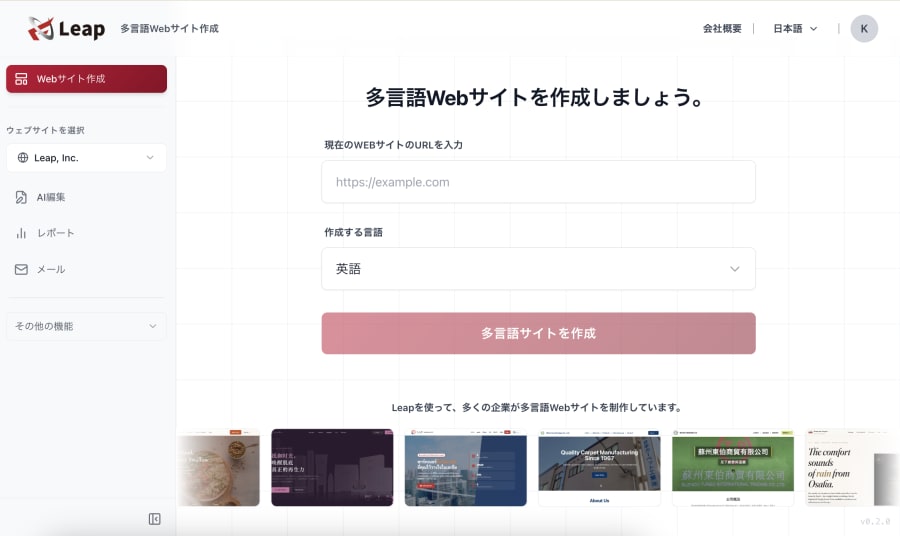
Leap, a cross-border ecommerce tool that lets AI handle marketing too, lets you build a multilingual, multi-currency online store just by chatting, and carry on into overseas marketing such as multilingual blog posts (SEO/AIO) and email newsletters. It also suggests and applies localization for each target country and shows access analytics by country. It supports three currencies (USD, EUR, and JPY), and its payment options are more limited than Shopify's (as of November 2026).
Monthly Cost Estimate at ¥100,000, ¥500,000, and ¥1,000,000 in Sales
Here is what each platform would cost per month at ¥100,000, ¥500,000, and ¥1,000,000 in overseas sales, calculated from published pricing only (as of November 2026; our own estimate; shipping, apps, advertising, and taxes not included).
| Platform | Calculation | ¥100,000 in sales | ¥500,000 in sales | ¥1,000,000 in sales |
|---|---|---|---|---|
| Shopify (Basic, monthly billing) | ¥4,850 monthly fee + 3.9% international card fee | ¥8,750 | ¥24,350 | ¥43,850 |
| ZenLink | 10% of sales (your domestic online store costs extra) | ¥10,000 | ¥50,000 | ¥100,000 |
| Amazon.com (Professional plan) | $39.99 monthly fee + 8–15% referral fee | $39.99 + ¥8,000–¥15,000 | $39.99 + ¥40,000–¥75,000 | $39.99 + ¥80,000–¥150,000 |
| Leap (Starter) | ¥9,800 monthly fee + 6% of sales | ¥15,800 | ¥39,800 | ¥69,800 |
The Shopify estimate assumes you use Shopify Payments and every order is paid with an international card. The Amazon estimate uses the 8–15% range stated for most categories, with the monthly fee left in US dollars.
The estimate shows that the larger a platform's percentage of sales, the faster its cost climbs as sales grow. At ¥100,000 in monthly sales, the gap between platforms stays within the ¥10,000s, but at ¥1,000,000 it widens from about ¥44,000 to more than ¥150,000.
That said, comparing fees alone hides the differences in what each platform actually does for you. ZenLink's 10% covers payment, international shipping arrangements, customer inquiries, and marketing support, and Amazon's referral fee buys access to the marketplace's audience. Shopify keeps monthly costs low, but you need to account separately for the work of marketing and for costs such as translation apps.
Which Cross-Border Ecommerce Platform Is Best for You?
The best cross-border ecommerce platform depends on your situation. Based on the comparison table and cost estimate, here is a rough guide.
- You want fine control over design and features, or to extend functionality extensively with apps: Shopify
- You want to keep your domestic online store as is and start by testing overseas orders: A proxy service such as ZenLink
- Your brand is not yet known and you want to build a sales track record quickly using a marketplace's audience: A global marketplace such as Amazon
- You already run a free online store in Japan and want to try overseas sales from there: Cross-border features of domestic carts such as BASE and STORES
- You want AI to handle overseas marketing such as SEO, email newsletters, and localization, without adding staff: Leap
You can also combine types. For example, you might test demand on a global marketplace while building customer data and your brand on your own online store.
FAQ
Q. Should I start cross-border ecommerce with my own store or a marketplace?
A. If your product is not yet known overseas, starting on a marketplace makes it easier to build a sales track record, because marketplaces already have the audience, payment, and logistics in place. If you want to convey your brand's identity or own your customer data, your own online store is the better fit.
Q. How much does a cross-border ecommerce platform cost?
A. Costs range widely by type, from no monthly fee with 10% of sales to a monthly fee of a few thousand to tens of thousands of yen plus payment processing fees. As of November 2026, ZenLink has no setup or monthly fee and charges 10% of sales, Shopify's Basic plan starts at ¥4,850 per month on monthly billing, and Leap has a free plan at ¥0 and a Starter plan from ¥9,800 per month (excl. tax). Shipping and app fees are extra.
Q. Can I use my own online store and a global marketplace at the same time?
A. Yes, you can run both. Top-ranking comparison articles also recommend testing demand on a marketplace while building your brand on your own store. Because inventory and order management will be split across channels, plan for that extra workload too.
Q. How should I handle translation for a multilingual online store?
A. The easiest approach is to use the platform's built-in features. On Shopify, you can choose manual translation with the Translate & Adapt app, automatic AI translation, CSV files, or third-party translation apps. With ZenLink, ZenMarket handles support for 19 languages. Rather than relying on machine translation alone, localization matters too: checking that product names, units, and wording fit local conventions.
Summary and Key Takeaway
When comparing cross-border ecommerce platforms, the more useful question is not "Which tool is cheapest?" but "Who takes on how much of the work of reaching overseas customers?" Shopify offers the most freedom, so you handle marketing and translation review yourself. ZenLink lets your existing site take overseas orders, so most of the interaction with overseas customers is handed to the proxy company. Amazon gives you access to its audience, so you accept its referral fees and marketplace rules.
In other words, differences in fees are also differences in the work you do in-house. Do you have people who can build out a site and run overseas marketing? Do you need a sales track record first, or do you want to grow your brand and customer data? If you put your team's capacity and goals into words before looking at the comparison table, the right type of platform narrows itself down.
Leap is a cross-border ecommerce tool that lets AI handle marketing too. Just chat with it to build a multilingual, multi-currency online store and run overseas marketing such as SEO and email newsletters.
References
- Pricing - Shopify Japan
- B2B - Shopify Help Center
- Languages - Shopify Help Center
- ZenLink - ZenGroup
- Amazon Global Selling - Amazon Seller Services Japan
- Pricing - Sell on Amazon
- AI information - Sell on Amazon (Chinese)
- Pricing - Leap
- 2026 Cross-Border Ecommerce Comparison: 8 Services - IT Trend (Japanese)
- How to Choose a Cross-Border Ecommerce Platform: 18 Marketplaces and Systems Compared - ECnoMikata (Japanese)