


Quick Overview: Choose Between "AI Built Into Your Store Builder" and "Single-Purpose AI Tools"
AI tools for cross-border ecommerce fall into two broad groups. The first is store builders such as Shopify, BASE, and Leap, where AI is built right into the platform you use to run your store. The second is tools such as ChatGPT, DeepL, and Canva, which help with one specific task like writing, translation, or image creation.
The easiest way to choose is to start with the question "Which part of the work do I want AI to take over?" If you want building your store and adding products to be easier, AI inside a store builder is the better fit. If you want better product descriptions and images, single-purpose AI tools are the way to go. And if you want AI to handle overseas marketing such as SEO articles and email newsletters, you need a tool that includes marketing features.
In this article, we compare each tool's pricing, fees, cross-border features, and marketing features based on official information as of November 2026. For a detailed look at how to use Shopify's AI features, see our guide to Shopify's AI features (Sidekick and Shopify Magic).
What AI Can Do for Cross-Border Ecommerce
AI is most useful in six areas of cross-border ecommerce: store building, translation and product descriptions, image creation, customer support, marketing, and analytics. Selling overseas adds work you don't have in domestic ecommerce, such as writing product descriptions and answering inquiries in foreign languages, so the time savings from AI are easier to feel.
| Area | Examples of what AI can do |
|---|---|
| Store building | Generate designs and pages from a description of your business; edit the design through chat |
| Translation and product descriptions | Translate Japanese product descriptions into other languages; write descriptions from a product name and features |
| Image creation | Remove or replace backgrounds in product photos; create banners and social media images |
| Customer support | Draft replies to inquiries in foreign languages |
| Marketing | Write and send SEO articles and email newsletters |
| Analytics | Summarize sales and traffic data; suggest improvements |
That said, no single tool necessarily covers every area. Each tool has different strengths, so the next section sorts them by type.
Types of AI Tools for Cross-Border Ecommerce
AI tools for cross-border ecommerce are easier to compare when you split them into two types: AI built into store builders, and single-purpose AI tools.
AI Built Into Cross-Border Store Builders
AI built into a cross-border store builder is a feature that lets you ask AI to add products, edit pages, or answer operational questions directly inside your store's admin. Because it works with your store data, you don't need to copy product information into a separate tool. The advantage is that you get AI together with the cross-border foundation of multiple languages, currencies, and payments.
Single-Purpose AI Tools
Single-purpose AI tools specialize in a specific task such as writing, translation, or image creation. Their advantage is that you can combine them with any ecommerce platform. On the other hand, you still have to put what they produce onto your store yourself.
Comparing AI Features in Cross-Border Store Builders (Shopify, BASE, Leap)
We compared Shopify, BASE, and Leap — three options small and mid-sized businesses often consider when launching their own cross-border store — on pricing, fees, cross-border support, marketing features, and B2B support. All information was checked on each company's official website as of November 2026. BASE is a popular Japanese online store builder.
| Item | Shopify | BASE | Leap |
|---|---|---|---|
| Monthly price | Basic: ¥4,850 billed monthly / ¥3,650 per month billed yearly and up | Standard: ¥0 / Growth: ¥19,980 billed monthly, ¥16,580 per month billed yearly | Free ¥0 / Starter ¥9,800 and up (excl. tax) |
| Fees | International card rate 3.9% (Basic) and down. Transaction fee of 2% (Basic) and down when using third-party payment providers | Standard: payment fee 3.6% + ¥40 plus 3% service fee. Overseas sales (Easy Overseas Sales) cost 5% of the payment amount only when an item sells | 6% of sales (includes credit card processing fees) |
| Main AI features | Sidekick (product description and image generation, task automation, web search, and more), theme generation | BASE AI (operational advice, adding new products through chat) | Store building and design editing through chat, localization suggestions and fixes, multilingual blog creation |
| Cross-border support (languages, currencies, payments) | Storefront translation and Shopify Markets on all plans. Local currency display and local payment methods require Shopify Payments | Sell to 100+ countries through a dedicated overseas cart via Easy Overseas Sales (a BASE subsidiary purchases on the buyer's behalf and handles international shipping, customs documents, and multilingual inquiries) | 1–10 languages depending on plan (unlimited on Enterprise). USD, EUR, and JPY across 22 major countries. Visa and Mastercard |
| Marketing features | Email (10,000 free emails per month on eligible plans), connections to third-party AI tools | No AI marketing features found on the official website | Multilingual email newsletters, CRM, analytics, AI-written multilingual blog posts (SEO/AIO, Basic plan and up) |
| B2B support | B2B features (up to 3 catalogs on Basic to Advanced, unlimited on Plus) | No dedicated features found on the official website | Dedicated B2B cart (company-specific pricing, volume discounts, quote requests, bank transfer and invoice payment) |
| Customizability | High (extend functionality extensively with apps) | Add features with the BASE Apps extensions | Built around templates and AI chat editing; not well suited to fine-grained customization |
Shopify's AI Features
The core of Shopify's AI is Sidekick, an AI assistant built into the admin. Shopify's official Help Center lists capabilities such as generating product descriptions and images, automating tasks with Shopify Flow, searching the web for market and competitor information, and generating custom apps. Many AI features in the admin are available at no additional cost, though Shopify notes that availability can vary by plan, device, and language.
For translation, Shopify's free official app Translate & Adapt offers free automatic translation through Google Translate for up to two languages. You can also connect third-party AI tools such as ChatGPT, Claude, and Gemini to your store and ask questions about your products and orders. Shopify's strength is how far you can extend it with apps, but you are expected to plan and run your own marketing.
BASE's AI Features
BASE's AI features are offered under the name "BASE AI." Since October 14, 2026, BASE has offered a feature that lets you ask AI about running your online store, and another that lets you describe a product in chat so AI can suggest a product name and description and fill them into the product registration screen. Both are free for all shops.
On the cross-border side, Easy Overseas Sales became a standard feature on March 18, 2026. AI detects the visitor's country and shows a dedicated overseas cart, and overseas orders are purchased on the buyer's behalf by want.jp, a BASE subsidiary. Shops simply ship to a domestic warehouse, and want.jp handles international shipping and customs documents. It suits sellers who want to try overseas sales with minimal effort.
Leap's AI Features
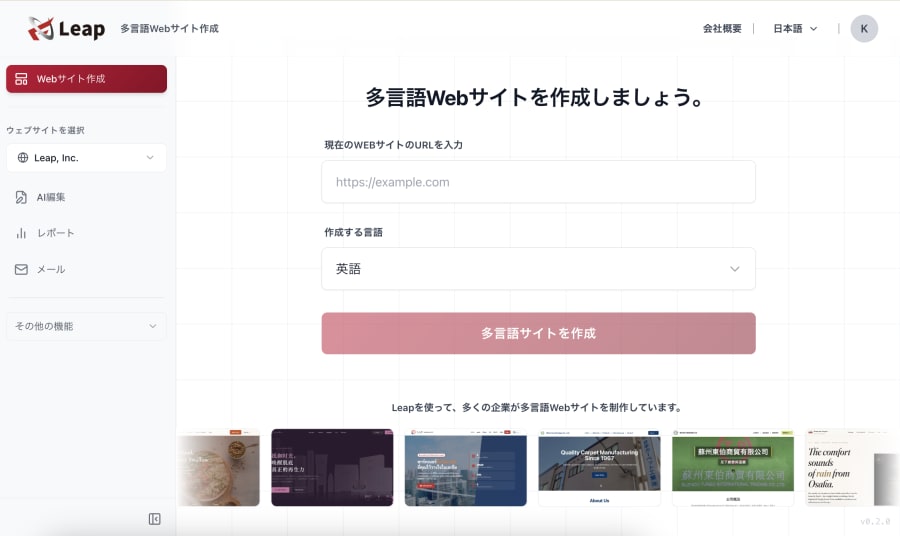
Leap, a cross-border ecommerce tool that lets AI handle marketing too, stands out because AI takes care of store building as well as localization suggestions, multilingual blog posts, and email newsletters — all through chat.
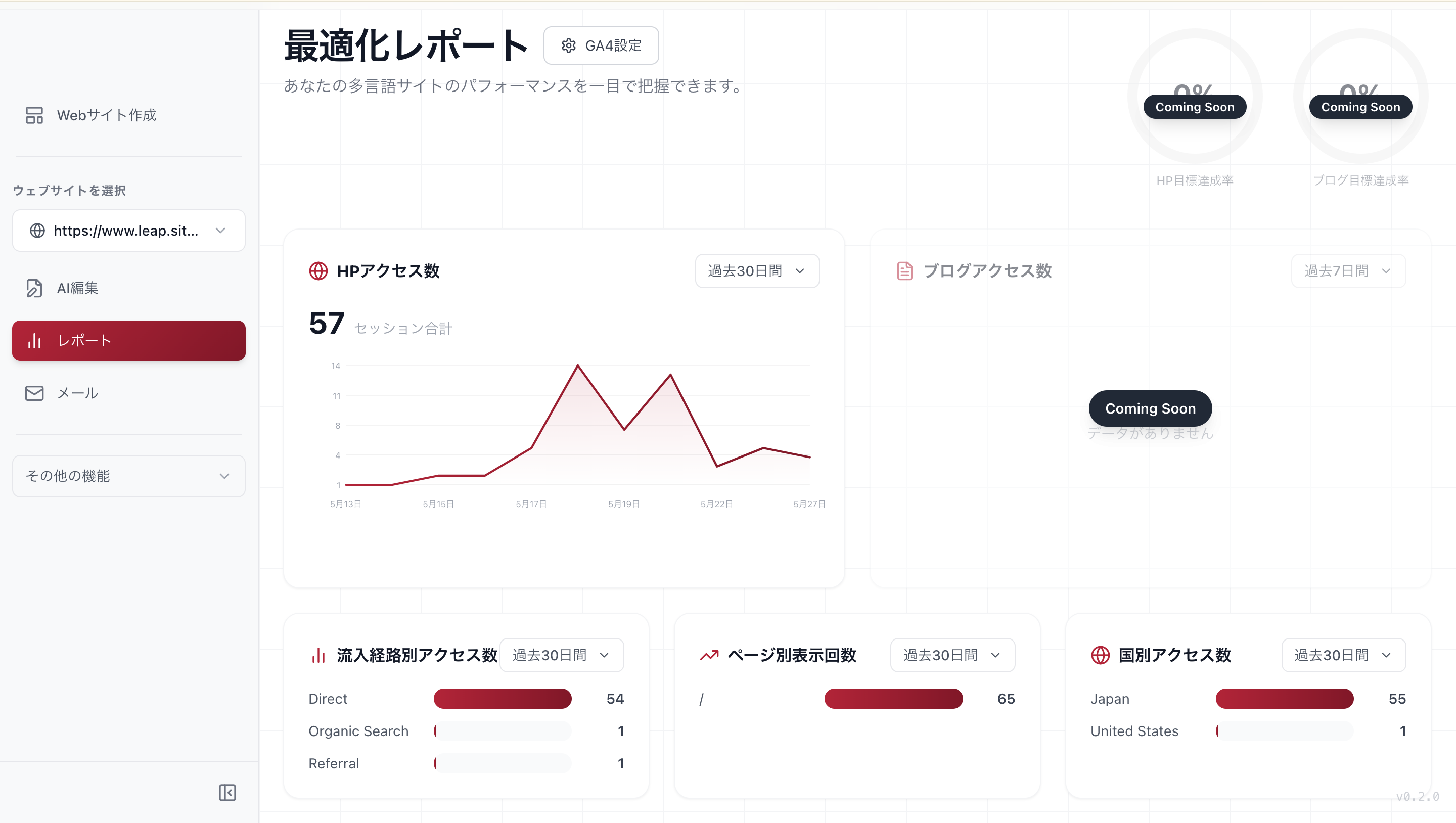
On the other hand, it supports three currencies, accepts Visa and Mastercard for card payments, and isn't as strong as Shopify at fine-grained design customization.
Comparing Single-Purpose AI Tools (ChatGPT, Claude, Gemini, DeepL, Canva)
Single-purpose AI tools fill the gaps that a store builder's AI doesn't cover. We compared five tools commonly used in cross-border ecommerce based on their official pricing pages as of November 2026.
| Tool | Main use | Pricing | How to use it for cross-border ecommerce |
|---|---|---|---|
| ChatGPT | Writing, translation, research | Free plan available. Paid plans include Go, Plus, and Pro | Drafting product descriptions, replying to inquiries in foreign languages, market research |
| Claude | Writing, translation, summarizing long text | Free plan available. Paid plans include Pro ($20/month, or $17/month billed yearly) | Writing and translating longer product descriptions and brand stories |
| Gemini | Writing, research | Free plan available. Paid plans include Google AI Plus (¥725/month) | Research and writing combined with Google services |
| DeepL | Translation | Free version available. Paid DeepL Pro adds features such as glossaries | Translating product descriptions; keeping brand names and technical terms consistent |
| Canva | Images and banners | Free version available. Canva Pro ¥1,180/month, Canva Business ¥1,880/month (per person) | Removing photo backgrounds, AI translation of banners, social media images |
General-purpose AI (ChatGPT, Claude, Gemini) can handle writing, translation, and research in one place. If you want consistent terminology across products, DeepL with its glossary feature is a good fit. Canva offers AI features such as automatic AI translation and photo background removal, which cut the work of recreating overseas banners for each language.
Estimated Costs of AI Tools for Cross-Border Ecommerce
We estimated monthly costs for combining single-purpose AI tools versus using a tool with marketing features. Figures are the prices listed on each company's pricing page as of November 2026 and exclude payment fees.
| Example setup | Breakdown | Monthly cost |
|---|---|---|
| Shopify + single-purpose AI | Shopify Basic (billed yearly) ¥3,650 + Canva Pro ¥1,180 + Google AI Pro ¥2,900 | ¥7,730 |
| Leap (including AI blog writing) | Basic ¥39,000 (excl. tax) | ¥39,000 |
| Leap (including email newsletters) | Starter ¥9,800 (excl. tax) | ¥9,800 |
Combining single-purpose AI tools keeps the monthly cost low. However, you have to put AI-generated text and images onto your store yourself, and plan and publish SEO articles and send newsletters on your own. Once you factor in the time spent on marketing or the cost of outsourcing it, the decision may change.
Things to Watch When Using AI for Cross-Border Ecommerce
The most important rule when using AI for cross-border ecommerce is to have a person review AI output before it goes live. The main points are:
- Have a person review translations: AI translation saves a lot of time on first drafts, but mistranslated specs, materials, or sizes can lead to returns and complaints. For the languages of your biggest markets, a native speaker's review gives you peace of mind.
- Check each country's labeling rules: Rules on ingredient labels and claims about effects differ by country. A person needs to confirm that AI-written copy follows the rules of the country you sell to.
- Decide how customer data is handled: If you share customer or order data with external AI tools, decide in advance what you share. Shopify, too, lets the store control which data and permissions are shared with external AI tools.
- Pricing and features change often: AI tools update their features and prices frequently. Check the official pricing page before signing up.
Recommendations by Goal
The right AI tool for cross-border ecommerce depends on your goal.
- You want to extend functionality with apps and fine-tune your design: Shopify, plus single-purpose AI as needed
- You want to test overseas sales easily while keeping your domestic online store: BASE (BASE AI and Easy Overseas Sales)
- You want to keep your current store and improve product descriptions and images: Single-purpose AI such as ChatGPT, DeepL, and Canva
- You want AI to handle overseas marketing (SEO, newsletters, localization) all in one place: Leap
For Shopify's latest moves, including selling through AI agents, see our guide to Shopify Editions Fall '26. For a broader comparison of platforms, see Best Cross-Border Ecommerce Platforms Compared.
FAQ
Q. Can AI translation alone handle product descriptions for cross-border ecommerce?
A. We recommend not relying on it alone and having a person review descriptions before publishing. AI translation greatly reduces the time it takes to create drafts, but mistranslated specs or sizes and wording that doesn't follow the target country's labeling rules are hard to catch without a human check. Keeping brand names and technical terms consistent with tools like DeepL's glossary makes reviews easier.
Q. Can I use AI tools for cross-border ecommerce for free?
A. Many tools offer a free tier. ChatGPT, Claude, Gemini, DeepL, and Canva all have free versions, Shopify's Translate & Adapt offers free automatic translation for up to two languages, and BASE AI is free for all shops. However, free versions come with usage and feature limits, so you'll likely consider a paid plan once you start operating in earnest.
Q. How much does it cost to use AI for cross-border ecommerce?
A. If you combine single-purpose AI tools, you can start for under ¥10,000 a month. In our estimate, combining Shopify Basic (billed yearly), Canva Pro, and Google AI Pro came to ¥7,730 a month (as of November 2026, excluding payment fees). If you want a tool to handle marketing work as well, expect to pay more for that.
Q. Can AI handle overseas marketing too?
A. Yes, if you choose a tool with marketing features. Most ecommerce tools focus their AI on building and managing the store, such as adding products and editing pages, but some tools can also use AI to write SEO articles and send email newsletters. Decide how much you want to hand over, then check the "Marketing features" row in the comparison table.
Summary and Key Takeaway
AI tools for cross-border ecommerce are easier to choose when you split them into AI built into store builders and single-purpose AI tools. Store builders like Shopify and BASE make building your store and adding products easier, while single-purpose tools like ChatGPT, DeepL, and Canva help improve product descriptions and images.
The comparison shows that AI saves the most time on "making things," while the work of attracting overseas customers still tends to fall on people. When choosing an AI tool, look beyond the monthly price and think about who will run marketing after launch — that way, you're less likely to stall once the tool is in place.
Leap is a cross-border ecommerce tool that lets AI handle marketing too. Just chat with it to build a multilingual, multi-currency online store and run overseas marketing such as SEO and email newsletters.
References
- Pricing - Shopify
- Sidekick - Shopify Help Center
- AI-powered tools - Shopify Help Center
- Translate & Adapt - Shopify App Store
- Email pricing - Shopify Help Center
- BASE - Online store builder
- BASE launches the "Picking List App" extension - Netshop Tantousha Forum (BASE, Inc. press release)
- BASE's AI features upgraded - BASE, Inc.
- BASE makes "Easy Overseas Sales" a standard feature from March 18 - Netshop Tantousha Forum (BASE, Inc. press release)
- Pricing - Leap
- ChatGPT Pricing - OpenAI
- Pricing - Claude
- Google AI Plans - Gemini
- DeepL Pro - DeepL
- Pricing - Canva