0. Introduction
Why a Simply Translated Site Fails in Urdu-Speaking Markets
Urdu is one of the world's most beautiful written languages — its Nastaliq script is widely considered among the most elegant writing systems ever developed, and it serves as the national language of Pakistan, one of the world's most populous countries (230+ million people). Urdu is also co-official in India and spoken widely in the Gulf diaspora, the UK, and other countries with Pakistani communities.
Pakistan's digital economy is growing rapidly — smartphone penetration is expanding, mobile payment systems (JazzCash, Easypaisa) are transforming financial access, and a young, mobile-first population is increasingly engaging with digital content.
Building an effective Urdu-language website requires mastering right-to-left (RTL) layout, the distinctive Nastaliq script, Pakistan's regulatory environment, and a mobile-first approach that works on the affordable Android devices that dominate the Pakistani market.
1. Understanding the Local Internet Environment and Rules
1-1. Writing Standards: Adapting Urdu for Your Target Region
Urdu uses the Nastaliq variant of the Perso-Arabic script — written right-to-left. This creates fundamental layout challenges that affect every element of the web design:
- Pakistan Standard Urdu: The formal standard used in government, media, and professional communications. Based on the Khariboli dialect of Hindi with heavy Perso-Arabic vocabulary. This is the appropriate register for business web content targeting Pakistani audiences.
- Indian Urdu: Urdu as used in India (particularly in Uttar Pradesh, Bihar, Telangana) — broadly similar to Pakistani Urdu in written form. The Devanagari Hindi-Urdu overlap means some Indian Urdu speakers are comfortable with both scripts. Web content targeting Indian Urdu speakers uses the same Nastaliq Urdu script as Pakistani content.
- Diaspora Urdu: UK and Gulf Pakistani communities use Standard Urdu — the same as Pakistani web content. No significant adaptation is needed.
- Urdu vs. Hindi distinction: Urdu and Hindi share the same grammatical base (both are forms of Hindustani) but differ in script (Urdu: Nastaliq Arabic script; Hindi: Devanagari) and in formal vocabulary (Urdu: Perso-Arabic; Hindi: Sanskrit). Literate Urdu and Hindi speakers cannot read each other's scripts. Content intended for Urdu-reading audiences must be in the Nastaliq Arabic script — not in Devanagari.
Set <html lang="ur" dir="rtl">. The dir="rtl" attribute is critical — it tells the browser to render the entire layout right-to-left. All text alignment, margin/padding direction, and navigation layout must be reversed compared to LTR pages.
1-2. Speed and Access Barriers: Handling Regulations and Third-Party Tools
Pakistan's internet environment has some significant platform-specific restrictions:
❌ Platform and access issues in Pakistan
- · TikTok has been repeatedly banned and reinstated in Pakistan — social media strategy should not depend on TikTok stability
- · VPN usage is widespread in Pakistan — some users access content through VPNs, which can affect geo-targeting
- · Heavy pages fail on affordable Android devices on Pakistan's variable mobile networks (often 3G or slow 4G outside major cities)
Pakistan's PEMRA (Pakistan Electronic Media Regulatory Authority) and PTA (Pakistan Telecommunication Authority) regulate digital content. The PTA has blocked access to various platforms and websites on grounds of "immoral," "un-Islamic," or politically sensitive content. Businesses should be aware of these content restrictions when designing Pakistani-facing web content.
1-3. Laws and Licensing: Local Requirements to Check Before Going Live
Pakistan's digital regulatory framework is evolving:
- PECA (Prevention of Electronic Crimes Act) 2016: Pakistan's primary cybercrime law — covering online offenses including cyberstalking, unauthorized access, hate speech online, and content deemed offensive to Islam or the military. Section 37 grants the PTA broad powers to block or remove content. Foreign businesses with Pakistani users should ensure their content does not trigger PECA provisions.
- Personal Data Protection Bill: Pakistan had a draft Personal Data Protection Bill under review as of the early 2020s, but a comprehensive data protection law had not yet been fully enacted at the time of this writing. Standard data protection best practices (clear privacy policy, minimal data collection, user consent) are advisable pending full legislative implementation.
- PTA registration: Significant online service providers operating in Pakistan are expected to register with the PTA. The requirements have been contested and evolving — foreign businesses should monitor current PTA requirements.
2. Content and SEO Strategies That Perform Locally
2-1. Localized Content Creation: Trustworthy Information That Resonates
Urdu content for Pakistani audiences has specific cultural expectations:
- Islamic cultural sensitivity: Pakistan is an Islamic republic — content must be respectful of Islamic values. Content involving alcohol, gambling, or content contrary to Islamic teaching is inappropriate and potentially illegal. Halal certification is a significant trust signal for relevant products.
- Religious references as warmth: Common Urdu greetings and expressions ("Assalam-o-Alaikum," "Inshallah," "Mashallah") appear naturally in Pakistani web and social content — using them appropriately signals cultural authenticity and respect.
- Family and community framing: Pakistani society is family-centric and community-oriented. Content that frames benefits in terms of family well-being, community benefit, and collective prosperity resonates more than purely individualistic messaging.
- Price transparency and value: Pakistani consumers are highly value-conscious — clear, transparent pricing, comparison content, and explicit value justification are important. Installment options (qist) are an effective conversion driver for higher-value purchases.
2-2. SEO Optimization: Targeting Local Search Engines
Google holds approximately 95–97% of Pakistani search market share. Standard Google SEO practices apply with Urdu-specific nuances:
- Urdu keyword research: Urdu search queries use Nastaliq Arabic script in Google — use Google Keyword Planner filtered to Pakistan for Urdu-language search volume data. Roman Urdu (typing Urdu words in Latin script) is also very common in Pakistan — many users type "ap ki website kaise banayein" in Roman rather than "آپ کی ویب سائٹ کیسے بنائیں".
- Content gap opportunity: High-quality Urdu web content is significantly underrepresented relative to Pakistan's population. Well-optimized Urdu content can achieve strong rankings with less competition than equivalent English content for Pakistani-specific queries.
- RTL technical SEO: Ensure your sitemap, robots.txt, and canonical tags are all correctly configured for the RTL Urdu site. Some SEO tools have limited support for RTL content — test sitemap generation and structured data validation with Urdu content specifically.
- Voice search: Urdu voice search is growing — conversational Urdu query patterns are increasingly valuable for content strategy.
2-3. Choosing a Domain and Server: How Infrastructure Affects Your Rankings
Server location for Urdu-language Pakistani-focused websites:
AWS does not have a data center in Pakistan. The nearest options are AWS Mumbai (ap-south-1) at approximately 25–40ms to Karachi and Lahore, or AWS Singapore (ap-southeast-1) at approximately 40–60ms. Both are commonly used for Pakistan-facing deployments. Cloudflare has a PoP in Karachi — enabling significantly faster CDN delivery to Pakistani users. For businesses requiring lower latency, the combination of a Mumbai origin server and Cloudflare with Karachi PoP is effective.
Domain choice: .pk signals Pakistani presence (requires Pakistani entity registration). .com.pk is commonly used by Pakistani businesses. .com is universally accepted.
3. Design and Font Best Practices for Urdu Websites
3-1. Color Psychology and Cultural Meaning: The Right Colors for Your Market
Pakistani color symbolism reflects Islamic tradition, national identity, and South Asian cultural heritage:
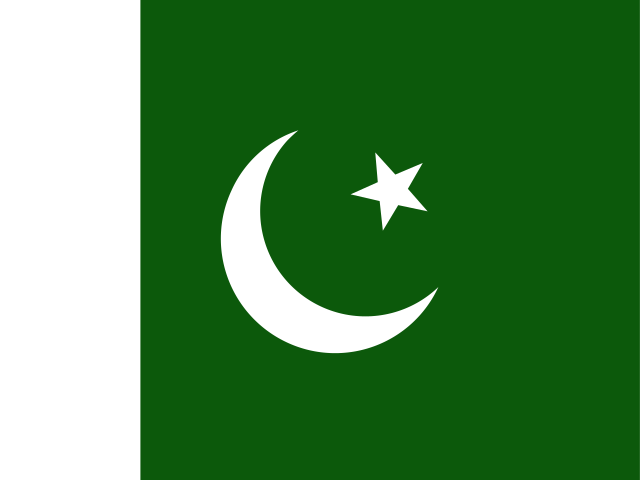
- 🟢 Green: The national color of Pakistan — the flag's green represents Islam. Deeply positive, patriotic, and auspicious. Green is the default "safe" and "positive" color choice for Pakistani audiences.
- ⚪ White: The second flag color. Purity, peace, and simplicity. A clean, trustworthy base color.
- ⚫ Black: Dignity and authority in Islamic tradition. Black and gold together signal premium positioning.
- 🔴 Red: Energy and urgency — effective for CTAs and limited-time offers. Used more cautiously than in Hindu-influenced cultures.
3-2. Recommended Fonts and Sizes: Settings for Optimal Readability
Urdu uses the Nastaliq variant of the Arabic script — a highly distinctive calligraphic style where letters flow in a diagonal direction with descending strokes. Nastaliq is more complex to render digitally than Naskh (the simpler Arabic style used in most Arabic-language web fonts).
"Noto Nastaliq Urdu" is Google's comprehensive Urdu Nastaliq font — the most widely available free option with good Unicode coverage. "Jameel Noori Nastaleeq" is the most beloved Urdu Nastaliq font among native Urdu readers — it closely resembles traditional calligraphy and is widely used in Pakistani publishing. Available via Font Squirrel and other sources. For web performance, self-host Nastaliq fonts rather than loading from external CDNs — Nastaliq font files are large and require subsetting for web performance.
Nastaliq is a flowing, diagonal script — it requires significantly more vertical space than equivalent Latin text. Set body text at 18–22px minimum, line-height 2.0–2.5. These larger values are not optional — Nastaliq is genuinely unreadable at line-heights designed for Latin fonts. Also set text-align: right as the global default for all Urdu content.
3-3. Layout and Information Density: Design Trends That Resonate
RTL layout is the most fundamental design consideration for Urdu websites — everything is mirrored:
- Complete RTL layout reversal: Navigation menus open from the right; text aligns right; content flows right-to-left; scroll indicators and progress bars move right-to-left; icons that indicate direction (arrows, chevrons) must point the opposite direction. Use CSS
direction: rtlglobally and test every component for RTL behavior. - Mixed content handling: URLs, email addresses, phone numbers, and English technical terms within Urdu text are written LTR — CSS
unicode-bidiand proper Unicode BiDi handling is required to correctly render mixed RTL/LTR content. - Mobile card layouts: Mobile card layouts still work well for RTL — but all directional elements (read more arrows, swipe indicators, progress indicators) must point RTL. Test every interactive component in RTL mode.
- Simplicity for slow connections: Many Pakistani users access the internet on affordable devices with slower connections. Prioritize fast-loading, content-first design over heavy visual experiences.
4. Contact Options and Social Media Integration
4-1. Building Conversion Paths: Contact Options and Social Media Channels
Pakistan's digital communication ecosystem:
- WhatsApp Business: WhatsApp is the dominant messaging platform in Pakistan — used by virtually all smartphone users for personal and business communication. A WhatsApp Business chat button is essential for Pakistani consumer-facing websites. Many Pakistani business interactions happen entirely through WhatsApp.
- JazzCash and Easypaisa payment: These are Pakistan's two dominant mobile wallet and payment platforms — combined, they cover the majority of Pakistani mobile payment users. JazzCash (Jazz telecom) and Easypaisa (Telenor/Easypaisa company) enable bank transfers, bill payments, and mobile commerce. For any Pakistani e-commerce, integration with at least one of these platforms is essential — credit card penetration in Pakistan is relatively low compared to mobile wallet adoption.
- Facebook: Facebook remains widely used in Pakistan for business pages, community groups, and customer communication. A Facebook Business Page is important for consumer-facing Pakistani businesses.
- Phone contact: A Pakistani phone number (+92) builds significant local trust. In Pakistan, WhatsApp contact often substitutes for traditional phone calls.
4-2. Mobile Optimization: Adapting to a Mobile-First Society
Pakistan is overwhelmingly mobile-first. Over 90% of Pakistani internet users access the web via smartphone — primarily affordable Android devices. Many users access the internet exclusively via mobile.
- Budget Android performance: Entry-level to mid-range Android devices (QMobile, Infinix, Samsung A-series in the PKR 15,000–40,000 range) dominate Pakistan's smartphone market. These have 2–3GB RAM and slower processors — test on budget Android profiles with CPU throttling enabled.
- Nastaliq on mobile: Nastaliq rendering on mobile can be problematic — not all mobile browsers support Nastaliq correctly. Use web font loading with a Naskh fallback for browsers that cannot render Nastaliq. Test specifically on Android Chrome and Samsung Internet Browser (common in Pakistan).
- Page weight: Under 1MB is the target for Pakistani mobile pages. Mobile data in Pakistan, while increasingly affordable (Jazz, Telenor, Ufone data packages), is still cost-sensitive for many users outside major cities.
- WhatsApp entry point: A significant proportion of Pakistani web traffic arrives through WhatsApp shares. Test your site in WhatsApp's in-app browser — Nastaliq font rendering in the WhatsApp browser should be verified specifically.
5. Summary
Checklist for Building a Successful Urdu Website
-
✔
Have you set
dir="rtl"on the HTML element and tested every UI component for correct RTL behavior? - ✔ Are you using Noto Nastaliq Urdu or Jameel Noori Nastaleeq with a line-height of 2.0–2.5 for correct Nastaliq readability?
- ✔ Have you integrated JazzCash or Easypaisa as primary Pakistani payment methods alongside WhatsApp Business?
- ✔ Is content appropriate for Islamic values and free of PECA-triggerable material?
- ✔ Does the site load in under 3 seconds on a budget Android device on a mobile connection?
- ✔ Does Nastaliq font render correctly in WhatsApp's in-app browser and Android Chrome?
Nastaliq RTL layout, Pakistan's mobile payment ecosystem, and PECA content restrictions make Urdu websites among the most technically demanding to implement correctly. Leap handles the RTL configuration, Nastaliq font setup, and localization infrastructure — so your Urdu website is technically correct and culturally appropriate from the first launch.