0. Introduction
Why a Simply Translated Site Fails in Thai-Speaking Markets
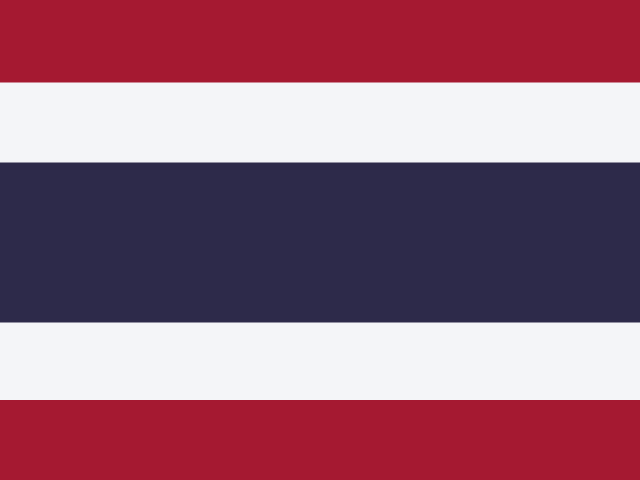
Thailand is Southeast Asia's second largest economy and one of the region's most digitally active markets — with over 50 million internet users, near-universal smartphone adoption, and a population that is highly engaged on social media, particularly Line and Facebook.
Thai is the sole official language of Thailand — spoken by approximately 70 million people as a first language, with Thai becoming the second language for many of the country's ethnic minorities (Chinese-Thai, Malay-Thai, hill tribes, etc.). Despite its relatively small speaker base compared to languages like Spanish or Hindi, Thailand's digital economy is sophisticated and growing rapidly in e-commerce, tourism, and financial services.
Thai script is one of the most complex writing systems for web implementation — and the cultural, legal, and platform environment has some critical specificities that make Thai-language websites require careful preparation.
1. Understanding the Local Internet Environment and Rules
1-1. Writing Standards: Adapting Thai for Your Target Region
Thai (ภาษาไทย) has a highly nuanced politeness register system that is central to Thai communication:
- Formal/polite Thai (ราชาศัพท์ and formal register): Thai has multiple levels of politeness encoded grammatically — from everyday polite to highly formal registers used with royalty and in official contexts. Business web content uses a respectful, polite register (using the polite particles ครับ for male speakers and ค่ะ/คะ for female speakers). The formality level signals professionalism and respect.
- Central Thai (Standard Thai): The standard dialect based on Central Thai/Bangkok Thai — the register used in all standard web content, education, and media. Understood across Thailand.
- Regional dialects: Northern Thai (คำเมือง, Kham Mueang), Northeastern Thai (Isan/Lao), Southern Thai, and others are widely spoken regionally. Web content is always in Standard Central Thai — regional dialects are not used for business web content.
- Thai and English coexistence: Many Thai websites, especially in Bangkok and for professional contexts, mix Thai and English — English brand names, technical terms, and borrowed vocabulary are common. This is not a deficiency; it reflects Thai digital culture.
Set <html lang="th">. Thai uses a distinct script (อักษรไทย) that requires dedicated Thai-supporting fonts and UTF-8 encoding throughout the stack.
1-2. Speed and Access Barriers: Handling Regulations and Third-Party Tools
Thailand operates an open internet environment with some important legal constraints:
❌ Critical content restrictions in Thailand
- · Lèse-majesté (มาตรา 112 / Section 112): Thailand's lèse-majesté law strictly prohibits any content that could be perceived as insulting, defaming, or threatening the Thai monarchy. This is enforced vigorously — even indirect criticism carries severe penalties. Foreign businesses must review all Thai-language content for potential violations.
- · Computer Crime Act (CCA): Thailand's CCA criminalizes content deemed false, harmful to national security, or offensive to public morality. Online publishers can be held liable for third-party comments on their platforms.
- · Missing Thai font — pages falling back to browser default Thai rendering are immediately recognizable as foreign and poorly localized
Platform access in Thailand is largely open — Google, Facebook, Instagram, YouTube, and Line all function normally. The key constraints are content-based rather than access-based.
1-3. Laws and Licensing: Local Requirements to Check Before Going Live
Thailand enacted a comprehensive data protection law in 2019:
- PDPA (Personal Data Protection Act B.E. 2562 / 2019): Thailand's GDPR-inspired data protection law, fully in force since June 2022. The enforcement authority is the Office of the Personal Data Protection Committee (PDPC). Key requirements: lawful basis for processing, explicit consent for sensitive data, data subject rights (access, correction, deletion, portability), breach notification (within 72 hours for high-risk breaches), and designation of a data controller representative if processing Thai residents' data from abroad.
- Cookie consent: PDPA requires consent for non-essential cookies. A Thai-language cookie consent banner that explains what is collected and provides opt-out options is legally required.
- Cross-border data transfer: PDPA restricts transferring personal data of Thai residents to countries without adequate data protection standards. International businesses should document their cross-border transfer legal basis.
2. Content and SEO Strategies That Perform Locally
2-1. Localized Content Creation: Trustworthy Information That Resonates
Thai digital consumers have specific expectations shaped by Thai cultural values (kreng jai, sanuk, and face/saving face):
- Warmth and approachability: Thai culture values warmth, friendliness, and smooth social interaction (the concept of "sanuk" — making things fun and enjoyable). Web copy that is overly cold, clinical, or aggressive clashes with Thai communication norms. Friendly, welcoming copy consistently outperforms hard-sell approaches.
- Face and indirect communication: Thai culture values maintaining face (saving both one's own face and the customer's). Avoid content that directly implies the customer is doing something wrong or is lacking — frame benefits positively rather than solving problems the customer currently has.
- Visual and aspirational content: Thai social media culture is highly visual and aspirational. Before/after content, lifestyle imagery, and celebrity/influencer association are very effective for consumer products.
- Festival calendar: Songkran (Thai New Year, April), Loi Krathong (November), and major Buddhist holidays are significant cultural touchpoints. Campaign content acknowledging Thai festivals builds cultural connection.
2-2. SEO Optimization: Targeting Local Search Engines
Google holds approximately 95–97% of Thai search market share. Standard Google SEO practices apply with Thai-specific nuances:
- Thai keyword research: Thai search queries use Thai script — use Google Keyword Planner filtered to Thailand for Thai-language search volume data. Thai keywords often differ significantly from direct translations of English terms.
- Word segmentation: Thai script has no spaces between words — this creates technical challenges for SEO tools and search engines. Google has good Thai word segmentation, but ensure your content uses natural Thai phrasing that aligns with how users actually search.
- Voice search growth: Thai voice search is growing, driven by the difficulty of Thai keyboard input. Natural spoken Thai queries are increasingly important for content strategy.
- Rich results in Thai: Thai search results support standard structured data types — FAQ schema, review schema, and product schema are effective for improving Thai search click-through rates.
2-3. Choosing a Domain and Server: How Infrastructure Affects Your Rankings
Server location for Thai-language websites:
AWS Singapore (ap-southeast-1) is the standard choice for Thailand-facing deployments — approximately 15–25ms to Bangkok. Google Cloud also uses Singapore as its Southeast Asia hub. Cloudflare has a Point of Presence in Bangkok, making Cloudflare CDN particularly effective for reducing Thai user latency.
Domain choice: .th signals Thai presence (requires registration with THNIC, needs Thai company registration). .co.th is commonly used by Thai businesses. .com is widely accepted and used by many foreign brands targeting Thailand.
3. Design and Font Best Practices for Thai Websites
3-1. Color Psychology and Cultural Meaning: The Right Colors for Your Market
Thai color symbolism is rich and context-specific — color carries strong day-of-the-week, astrological, and royal associations in Thai culture:
- 🟡 Yellow: Royal color — strongly associated with the monarchy and Monday (auspicious for royalty). Extremely positive connotation in Thai culture. Yellow flowers (marigolds) are offered at temples. The yellow "We love the King" movement has given yellow strong patriotic and royalist associations.
- 🔴 Red: Sunday's color. Energy, luck (influenced by Chinese-Thai culture). Associated with good fortune in Thai-Chinese business tradition. Widely used for CTAs and promotional content.
- 🔵 Blue: Friday's color and the color associated with the current King Vajiralongkorn. Trust and royalty. Very safe and positive choice in contemporary Thai design.
- ⚪ White: Purity, cleanliness, and Buddhist virtue. Associated with Wednesday. Used extensively as a clean base color in Thai web design.
3-2. Recommended Fonts and Sizes: Settings for Optimal Readability
Thai script (อักษรไทย) is an abugida — a complex writing system where consonants carry an inherent vowel and additional vowels are written as diacritics above, below, and around the consonant. Thai requires dedicated Thai-supporting fonts.
"Noto Sans Thai" is Google's comprehensive Thai font — excellent Unicode coverage and clean modern rendering. "Sarabun" is a purpose-built Thai font popular for government and educational use — readable and authoritative. "Kanit" is a contemporary Thai font popular in modern brand design — slightly geometric and modern. All three are available via Google Fonts.
Thai body text requires larger minimum sizes than Latin text — set at 16–18px minimum, line-height 1.8–2.0. Thai has diacritics placed above and below consonants — insufficient line-height causes diacritics from adjacent lines to collide, making text unreadable. Always test Thai font rendering at multiple sizes before finalizing.
3-3. Layout and Information Density: Design Trends That Resonate
Thai web design reflects a culture that values warmth, visual richness, and social validation:
- Visual-first, social-influenced design: Thai digital culture is heavily influenced by Instagram, TikTok, and Line — high-quality product imagery, lifestyle photography, and video content are primary trust builders. Product pages with many high-quality images perform better than text-heavy equivalents.
- Social proof and community: Thai consumers are highly influenced by peer recommendation and social proof. Review counts, user ratings, and "X people are viewing this now" social signals are effective conversion drivers.
- Line Official Account integration: The Line Official Account QR code displayed on website is a primary conversion action for Thai audiences — equivalent to a WeChat QR in China or WhatsApp in Southeast Asia.
- Mobile-first card layouts: Thailand's mobile-dominant internet means mobile card-based layouts are the baseline. Line's mobile interface has shaped Thai users' expectations for clean, card-based mobile content presentation.
4. Contact Options and Social Media Integration
4-1. Building Conversion Paths: Contact Options and Social Media Channels
Thailand has a highly distinctive communication ecosystem centered on Line:
- Line Official Account (LINE OA): Line is Thailand's dominant messaging platform — with over 47 million active Thai users (~67% of the population). A Line Official Account is essential for any consumer-facing business in Thailand — equivalent to KakaoTalk in Korea or WeChat in China. Displaying your Line OA QR code prominently on your website is a primary conversion action. Line OA enables push notifications, customer service chat, automated responses, and rich message campaigns.
- Facebook and Facebook Messenger: Thailand has extremely high Facebook penetration — it remains the dominant social platform for older demographics and many businesses use Facebook Pages as a primary web presence. Facebook Messenger chat integration adds a familiar contact channel for Thai users.
- PromptPay payment: PromptPay is Thailand's national instant payment system — linked to Thai ID numbers or phone numbers, enabling instant bank-to-bank transfers. For Thai e-commerce and service businesses, PromptPay is a standard payment option alongside credit cards. Thailand's KBank, SCB, Kasikorn, and others all support PromptPay QR payments.
- Phone contact: A Thai phone number (+66) builds local trust. Bangkok landlines (+66-2) signal established business presence.
4-2. Mobile Optimization: Adapting to a Mobile-First Society
Thailand is one of Southeast Asia's most mobile-first markets. Over 95% of Thai internet users access the web via smartphone — with Line and Facebook being the primary entry points to web content.
- Line in-app browser: An enormous proportion of Thai web traffic arrives through Line link shares. Line's in-app browser is effectively a primary Thai browser — test your site specifically in Line's in-app browser for rendering compatibility.
- Thai font on mobile: Thai diacritics are especially important to test on mobile screens — at small sizes, insufficient line-height causes Thai text to become illegible. Always test Thai typography at mobile screen sizes.
- Android mid-range: Android holds approximately 70% of the Thai smartphone market. Mid-range Samsung, OPPO, and Vivo devices are common. Performance test on representative mid-range Android hardware.
- PromptPay mobile UX: PromptPay QR payments must display correctly on mobile — the QR code must be large enough to scan comfortably on a phone screen, and deep links to banking apps should work correctly across the major Thai banking apps.
5. Summary
Checklist for Building a Successful Thai Website
- ✔ Are you using a Thai-optimized font (Noto Sans Thai, Sarabun, or Kanit) with generous line-height (1.8–2.0) for diacritic clearance?
- ✔ Has all Thai content been reviewed for PDPA compliance and for any potential lèse-majesté issues?
- ✔ Have you set up a Line Official Account with a visible QR code on your website?
- ✔ Is PromptPay integrated as a payment option for Thai users?
- ✔ Does the site render correctly in Line's in-app browser?
- ✔ Are you hosted in AWS Singapore (ap-southeast-1) with a Bangkok CDN PoP for optimal Thai user performance?
Thai script rendering, PDPA compliance, the lèse-majesté content requirement, and Line's central role in Thai digital life make Thai-language websites require careful technical and legal preparation. Leap handles the Thai script configuration and localization infrastructure — so your Thai website is correct, compliant, and performs from the first day.