0. Introduction
Why a Simply Translated Site Fails in Portuguese-Speaking Markets
Portuguese is the sixth most spoken language in the world — with over 260 million speakers across Brazil, Portugal, Angola, Mozambique, Cape Verde, and other countries. It's also the fastest-growing European language in number of speakers, driven by Brazil's expanding population and global influence.
Brazil alone is home to over 215 million people, the ninth largest economy in the world, and one of the world's largest and most sophisticated e-commerce markets. Brazil's digital consumer base is massive, mobile-first, and highly engaged — with distinctive payment preferences (Pix, Boleto Bancário) and platform behaviors that differ significantly from Portugal and other Portuguese-speaking markets.
This guide covers what you need to know to build a Portuguese-language website that works — in Brazil, in Portugal, or across both.
1. Understanding the Local Internet Environment and Rules
1-1. Writing Standards: Adapting Portuguese for Your Target Region
Brazilian Portuguese (pt-BR) and European Portuguese (pt-PT) are distinct enough that mixing them is immediately noticeable to native speakers — and signals a lack of investment in localization:
- Brazilian Portuguese (pt-BR): The dominant variant by number of speakers — Brazil has over 200 million Portuguese speakers, compared to Portugal's 10 million. Brazilian Portuguese is more open in vowel sounds, uses "você" (you) as the standard second person (while Portugal uses "tu"), and has absorbed many English and indigenous loanwords. The written standard was simplified by the 2009 orthographic reform, which Portugal eventually adopted, creating more alignment — but vocabulary, register, and cultural references remain meaningfully different.
- European Portuguese (pt-PT): More formal register, more synthetic tense constructions, preference for "tu" in informal contexts. Direct translations from Brazilian Portuguese can sound informal or imprecise to European Portuguese readers. A Portuguese person reading Brazilian web copy immediately recognizes it as "Brazilian."
- African Portuguese (Angola, Mozambique, Cape Verde): Broadly similar to European Portuguese but with distinct local vocabulary and cultural references. The standard European Portuguese written norm is broadly applicable, with attention to local cultural context.
Set <html lang="pt-BR"> for Brazil, lang="pt-PT" for Portugal, or lang="pt" for a generic target. Portuguese uses accented characters (á, ã, â, é, ê, í, ó, ô, õ, ú, ç) — ensure your font and CMS handle these correctly in content and URLs.
1-2. Speed and Access Barriers: Handling Regulations and Third-Party Tools
Brazil and Portugal operate open internet environments with standard platform access. Brazil-specific technical considerations:
❌ Common technical issues for Portuguese-language websites
- · Accepting only international cards — the majority of Brazilian online purchases use Pix or Boleto Bancário, not credit/debit cards
- · Servers in Europe serving Brazilian users without a CDN — Brazil-to-Europe latency is high (120–180ms), creating noticeably slow experiences
- · Mixing pt-BR and pt-PT content — signals cheap localization and reduces trust with both audiences
Brazil is a geographically large country with significant connectivity variation — São Paulo and Rio de Janeiro have fast fiber and 5G, while the North and Northeast regions have slower connectivity. Optimization for mid-range mobile is important for reaching all of Brazil.
1-3. Laws and Licensing: Local Requirements to Check Before Going Live
Both Brazil and Portugal have strong data protection frameworks:
- LGPD (Lei Geral de Proteção de Dados) — Brazil: Brazil's GDPR-equivalent, enacted in 2018 and enforceable since 2021. The national authority is ANPD (Autoridade Nacional de Proteção de Dados). Key requirements: lawful basis for processing, consent (with specific requirements for sensitive data), data subject rights, breach notification, and data protection officer (DPO) obligation for certain organizations. LGPD applies to any processing of data of Brazilian residents — regardless of where the business is located.
- GDPR (Portugal/EU): Portugal is an EU member state — GDPR applies in full. Portugal's national DPA (CNPD) is the enforcement authority. As with all EU markets, a cookie consent banner compliant with GDPR is required.
- Brazil consumer protection (CDC — Código de Defesa do Consumidor): Brazil's Consumer Defense Code applies to online commercial relationships with Brazilian consumers. Requirements include: clear pricing, transparent return policies, 7-day cancellation right for online purchases, and mandatory product information in Portuguese.
2. Content and SEO Strategies That Perform Locally
2-1. Localized Content Creation: Trustworthy Information That Resonates
Brazilian and Portuguese audiences have distinct content preferences:
- Brazil — warm, relational tone: Brazilian culture values warmth, personal connection, and approachability. Business copy in Brazil is often more informal and personal than in European markets. "Você" is the standard second person in business Brazilian Portuguese. Content that feels friendly and relatable outperforms cold, formal copy in most Brazilian consumer contexts.
- Portugal — more formal European register: Portuguese business content tends toward a more formal register. "Você" is increasingly used in formal contexts, but "tu" appears in youth-oriented and informal contexts. Portuguese consumers expect a tone that signals respect and professionalism.
- Price sensitivity (Brazil): Brazilian consumers are highly price-sensitive — EMI installment options (parcelamento) are essential in e-commerce. "12x sem juros" (12 installments interest-free) is a standard conversion driver.
- Brazilian festival calendar: Carnival, São João, Black Friday (huge in Brazil), and Copa events are major peaks. Seasonal campaigns around these events outperform generic promotions significantly.
2-2. SEO Optimization: Targeting Local Search Engines
Google dominates in both Brazil (~97%) and Portugal (~95%). Standard Google SEO practices apply with regional nuances:
- hreflang for pt-BR vs. pt-PT: If serving both audiences, hreflang tags with
pt-BRandpt-PTare essential — they tell Google which version to serve to which audience. Without hreflang, Google may serve the wrong variant to each market. - Brazilian search behavior: Brazilian users are heavy search users — Google is deeply integrated into Brazilian digital life. "Como fazer [x]" (how to do x), "O que é [x]" (what is x), and review-seeking queries ("[product] vale a pena") are very common search patterns.
- Rich snippets in Portuguese: Brazilian e-commerce SEO strongly benefits from review schema, FAQ schema, and product schema with Portuguese-language content — rich results significantly improve click-through rates.
- Portugal B2B SEO: For B2B targeting the Portuguese market, LinkedIn content and Niche Portuguese industry directories (rankings in specialized Portuguese B2B publications) can supplement organic search effectively.
2-3. Choosing a Domain and Server: How Infrastructure Affects Your Rankings
Server location strategy differs significantly between Brazil and Portugal targets:
- Brazil: AWS São Paulo (sa-east-1) is the standard choice for Brazil-focused deployments. It's AWS's only South American region and delivers sub-10ms latency to São Paulo and Rio users. A CDN with Brazil PoPs (Cloudflare has São Paulo and Rio de Janeiro) is important for reaching Northern and Northeastern Brazil users efficiently. Google Cloud also has a São Paulo region.
- Portugal (EU): AWS Lisbon (eu-south-1) — AWS opened a Lisbon region in 2023, making it the natural choice for Portugal-focused sites. Paris (eu-west-3) or Ireland (eu-west-1) are viable fallbacks. GDPR data residency expectations make EU-hosted servers strongly preferred.
Domain choice: .com.br is strongly preferred for Brazil-focused businesses — it signals local presence and boosts SEO for Brazilian searches. .pt is the equivalent for Portugal (requires EU/EEA presence). .com is universally accepted for international positioning.
3. Design and Font Best Practices for Portuguese Websites
3-1. Color Psychology and Cultural Meaning: The Right Colors for Your Market
Color preferences differ meaningfully between Brazil and Portugal:
- 🟡 Yellow and green (Brazil): The Brazilian flag's yellow and green are strongly associated with national identity — used extensively in marketing during World Cup and national holidays. Vibrant, warm colors resonate with Brazilian audiences.
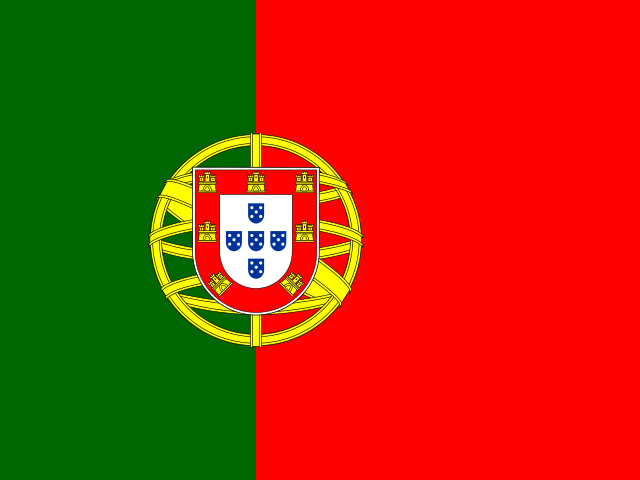
- 🔵 Blue (Portugal): The Portuguese flag's blue and white give blue a strong cultural resonance. Portuguese digital design trends toward more measured, European palette conventions — similar to Spain and other Western European markets.
- 🔴 Red (both): Energy, urgency, and action. Effective for CTAs in both markets. Associated with passion (in Brazilian culture) and the Portuguese flag's red.
- 🟢 Green: Nature and growth broadly. In Brazil, green carries strong national flag associations alongside yellow.
3-2. Recommended Fonts and Sizes: Settings for Optimal Readability
Portuguese uses the Latin alphabet with accented characters. Standard Latin web fonts apply:
"Inter" is the modern choice for clean, professional web content in both Brazilian and European Portuguese contexts. "Roboto" is highly familiar to Brazilian Android users (Google's native font). Both support the full Latin extended character set required for Portuguese accented characters.
Body text at 16px, line-height 1.6–1.8. Portuguese text is typically slightly longer than English equivalents (Romance language constructions add words). Ensure buttons, navigation, and card titles can accommodate slightly longer strings without truncation.
3-3. Layout and Information Density: Design Trends That Resonate
Brazil and Portugal have different design sensibilities reflecting their distinct cultural contexts:
- Brazil — vibrant and conversion-focused: Brazilian e-commerce design is aggressive and conversion-optimized — prominent discount badges, countdown timers, installment payment callouts, and strong CTAs. Brazilian consumers respond to urgency signals and clear value communication.
- Portugal — more restrained European aesthetic: Portuguese web design follows Western European minimalism trends more closely — clean layouts, quality photography, and measured use of color. Luxury and heritage brands do particularly well with understated elegance.
- Mobile shopping Brazil: Brazil's mobile e-commerce is massive — Shopee, Amazon, and Mercado Livre dominate and have set strong expectations for mobile commerce UX. A clean, app-like mobile shopping experience is expected.
- Social proof both markets: Reviews and ratings are important in both Brazil (consumers heavily research before buying) and Portugal. In Brazil, aggregated ratings with review counts are particularly high-impact conversion elements.
4. Contact Options and Social Media Integration
4-1. Building Conversion Paths: Contact Options and Social Media Channels
Communication channel preferences differ significantly between Brazil and Portugal:
- WhatsApp (Brazil — essential): Brazil is WhatsApp's second largest market in the world. WhatsApp is used for virtually all personal and business communication — it's the primary customer service channel for Brazilian e-commerce. A WhatsApp Business integration with a floating chat button is standard for any Brazilian consumer-facing website.
- Pix payment (Brazil — critical): Pix is Brazil's central bank instant payment system — launched in 2020 and adopted by over 100 million Brazilians within two years. It's now the most used payment method in Brazil for online transactions. Supporting Pix is non-negotiable for any Brazilian e-commerce.
- Boleto Bancário (Brazil): While Pix is displacing Boleto, Boleto remains important for consumers without bank accounts or who prefer delayed payment. Integrating both Pix and Boleto covers the full Brazilian consumer payment landscape.
- Email/forms (Portugal): Portuguese B2B and B2C communication relies more on email and contact forms than instant messaging. A professional contact form with stated response time is the Portuguese B2B standard. LinkedIn is heavily used by Portuguese professionals.
4-2. Mobile Optimization: Adapting to a Mobile-First Society
Brazil is a mobile-first market. Over 90% of Brazilian internet users use smartphones, with the majority accessing the internet primarily via mobile. Portugal has slightly higher desktop usage in professional contexts but is broadly mobile-dominant for consumer traffic.
- Android dominance in Brazil: Android holds ~80% of Brazil's smartphone market — optimize for Android Chrome specifically. Samsung Galaxy A-series and Motorola Moto G-series are the most common devices.
- WhatsApp in-app browser (Brazil): Enormous proportion of Brazilian web traffic arrives through WhatsApp link shares. Test and optimize for WhatsApp's in-app browser.
- Pix on mobile: Pix mobile payments must work smoothly on the site — QR code display and deep links to banking apps must function correctly across the Android device range.
- Performance: São Paulo and Rio users have fast connections; Northern/Northeastern Brazil has slower mobile networks. Target sub-3 second load times across the Brazilian mobile range.
5. Summary
Checklist for Building a Successful Portuguese Website
- ✔ Have you chosen Brazilian Portuguese (pt-BR) or European Portuguese (pt-PT) consistently, and set up hreflang if serving both?
- ✔ For Brazil: have you integrated Pix (and optionally Boleto) as primary payment methods alongside WhatsApp Business?
- ✔ Have you implemented LGPD-compliant data processing consent and a Portuguese-language privacy policy?
- ✔ For Portugal: is your cookie consent banner GDPR-compliant?
- ✔ Are you hosted in AWS São Paulo for Brazil or AWS Lisbon for Portugal — with a CDN for consistent delivery?
- ✔ Does the site render correctly and load quickly in WhatsApp's in-app browser (for Brazil)?
The pt-BR / pt-PT split, Brazil's unique payment ecosystem (Pix, Boleto), and LGPD compliance requirements make Portuguese websites significantly more complex than they appear. Leap handles the localization infrastructure and payment integration — so your Portuguese website works correctly from the start in both Brazil and Portugal.