0. Introduction
Why a Simply Translated Site Fails in Korean-Speaking Markets
South Korea has one of the world's highest internet penetration rates, the fastest average internet speeds globally, and a population of highly engaged digital consumers with distinct platform preferences, cultural expectations, and legal requirements — many of which differ significantly from those in Western markets or other Asian countries.
The most important single fact about Korean digital marketing: Google is not the primary search engine. Naver (네이버) is — and optimizing for Naver requires a different technical and content strategy than Google SEO.
This guide covers what makes Korean-language websites succeed: from Naver SEO and KakaoTalk integration to Korean typography, PIPA compliance, and the design conventions that earn Korean consumers' trust.
1. Understanding the Local Internet Environment and Rules
1-1. Writing Standards: Adapting Korean for Your Target Region
Korean (한국어) is spoken by approximately 80 million people — primarily in South Korea and North Korea, with diaspora communities in China, the US, Japan, and across Southeast Asia. South Korea is the primary commercial target for Korean-language websites.
- Standard Korean (표준어): The Seoul dialect-based standard used in all formal communications, business, media, and web content. This is what you should use for any professional Korean-language website.
- Formality levels (존댓말 / 반말): Korean has grammatically distinct formal (존댓말, jondaemal) and informal (반말, banmal) speech registers. All business and professional web content uses 합쇼체 (hapsyo-che — formal formal) or 해요체 (haeyo-che — polite casual). Using informal speech (반말) in a business context would be highly inappropriate unless the brand explicitly targets youth culture.
- Hanja influence: Korean uses Hangul (한글) script — a phonetic alphabet invented in the 15th century. While Hanja (Chinese-derived characters) were previously used for vocabulary, modern Korean digital content is written in Hangul exclusively, with occasional English loanwords (called 외래어) for technical and brand terms.
Set <html lang="ko">. Korean uses Hangul — a phonetic script that requires dedicated Korean-supporting fonts. Ensure UTF-8 encoding throughout your stack for correct Korean character handling.
1-2. Speed and Access Barriers: Handling Regulations and Third-Party Tools
South Korea has the world's fastest and most widely deployed internet infrastructure — fiber-to-the-home (FTTH) is the norm, and 5G is near-universal in cities. However, there are platform-specific considerations unique to the Korean market:
❌ Common issues for Korean-market websites
- · Optimizing only for Google — Naver requires a completely different SEO approach and accounts for ~50%+ of Korean searches
- · Missing KakaoTalk Channel — Korea's dominant messaging app is essential for B2C customer communication
- · Non-compliance with PIPA (Personal Information Protection Act) — Korea's strict data privacy law has significant mandatory disclosures
Internet Explorer was used widely in Korea far longer than in other markets due to legacy government and banking website requirements (ActiveX). While this has largely resolved, older Korean users may still use IE-based or Edge-legacy browsers — test for IE11 compatibility if targeting an older demographic.
1-3. Laws and Licensing: Local Requirements to Check Before Going Live
South Korea has some of the world's strongest data protection laws:
- PIPA (개인정보 보호법 — Personal Information Protection Act): Korea's comprehensive personal data protection law, first enacted in 2011 and significantly amended in 2023. PIPA applies to any business collecting personal data of Korean residents — including foreign businesses. Key requirements: consent for collection, purpose limitation, mandatory breach notification (within 72 hours), data retention limits, and a mandatory internal privacy officer (CPO) for certain organizations. The Personal Information Protection Commission (PIPC) is the enforcement authority.
- Mandatory disclosure requirements: Korean websites that collect personal data must prominently display a "개인정보처리방침" (privacy policy) with specific required contents. PIPA requirements go further than GDPR in some areas — including specific requirements for consent collection forms and mandatory fields in the privacy policy.
- Location data: Collecting and using location data in Korea requires additional consent under the Location Information Act (위치정보의 보호 및 이용 등에 관한 법률).
2. Content and SEO Strategies That Perform Locally
2-1. Localized Content Creation: Trustworthy Information That Resonates
Korean consumers are sophisticated, high-expectation digital users. Content quality and presentation directly affect conversion:
- Thoroughness signals professionalism: Korean consumers expect detailed, comprehensive information before making decisions. Very sparse pages or minimal copy reads as insufficient and creates doubt about the business's credibility. Detailed specifications, clear pricing, and comprehensive FAQs are expected.
- Review culture (후기): Korean consumers place extraordinary weight on 후기 (user reviews and testimonials). Authentic Korean-language reviews from real users are one of the highest-impact conversion elements. Naver Blog reviews and Naver Café posts discussing your product/service carry more weight than paid ads for many Koreans.
- Certification and quality marks: Korean consumers trust visible certifications — 인증 (certification) marks, awards from Korean industry bodies, and Korean government quality seals (KC mark, etc.) are significant trust signals.
- Before/after and transformation content: Particularly effective for beauty, health, fitness, and food products — Korean digital culture has a strong appetite for dramatic visual demonstrations of product results.
2-2. SEO Optimization: Targeting Local Search Engines
Naver holds approximately 55–60% of Korean search market share; Google holds approximately 30–35%. Both engines require attention, but Naver demands a distinct strategy:
- Naver SEO fundamentals: Naver strongly favors content within its own ecosystem — Naver Blog, Naver Café, and Naver Smart Store rank highly in Naver search results. For businesses without these accounts, a standalone website will struggle to appear in Naver's main "comprehensive search" (통합검색) results. Creating and maintaining a Naver Blog with Korean content is strongly recommended.
- Naver Webmaster Tools (네이버 서치어드바이저): Submit your site and sitemap at webmaster.naver.com — the equivalent of Google Search Console for Naver. This is required for effective Naver indexing.
- Google SEO (standard): Standard Google SEO practices apply for the 30–35% of Korean searches on Google — keyword research with Korean terms, Core Web Vitals, structured data, and mobile optimization.
- Kakao search: Daum (acquired by Kakao) powers Kakao's search function with approximately 5–10% market share. The SEO signals are similar to Google; it's worth including but secondary.
2-3. Choosing a Domain and Server: How Infrastructure Affects Your Rankings
Server location within or near Korea is important for both performance and Naver SEO:
AWS Seoul (ap-northeast-2) is the standard choice for Korea-focused deployments. Google Cloud and Azure also have Seoul regions. Naver's ranking algorithm favors sites that load quickly for Korean users — a Seoul-region server delivers sub-5ms latency to Korean users.
Domain choice: .kr signals Korean presence and is preferred for Korea-focused businesses (requires Korean domestic registration). .co.kr is commonly used by Korean companies. .com is widely accepted — many major foreign brands targeting Korea use .com. For Naver SEO purposes, hosting on a fast Korean server matters more than the TLD choice.
3. Design and Font Best Practices for Korean Websites
3-1. Color Psychology and Cultural Meaning: The Right Colors for Your Market
Korean color associations blend Confucian tradition, five-element philosophy (오행), and contemporary global design trends:
- ⚪ White and clean neutrals: Purity, cleanliness, and modern minimalism. Korean design — particularly in K-beauty, tech, and premium products — often uses clean white-based palettes that communicate precision and quality. White also has positive connotations in contemporary Korean culture (unlike some other East Asian contexts).
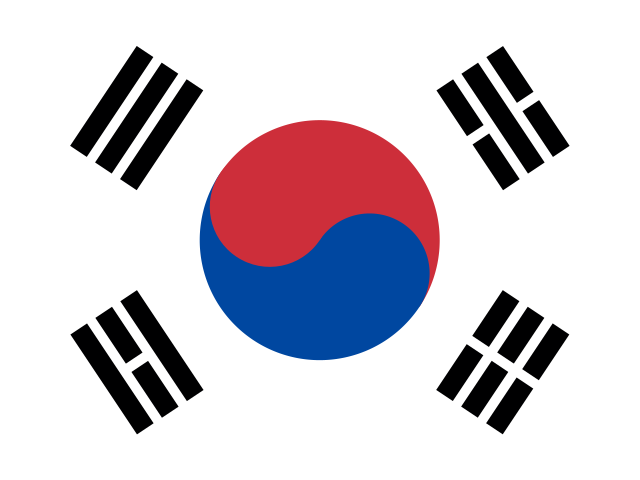
- 🔴 Red: Passion, energy, and vitality. One of the Taegukgi flag colors. Used extensively in Korean consumer brands, sports, and sale/promotion indicators. Red is the default "action" color in Korean e-commerce.
- 🔵 Blue: Trust, stability, and professionalism. Common in Korean financial, tech, and government sectors. KakaoTalk uses blue; Samsung is blue.
- 🟡 Yellow/gold: The KakaoTalk brand color — highly recognizable and associated with the dominant messaging platform. Premium, warmth, and approachability in broader contexts.
3-2. Recommended Fonts and Sizes: Settings for Optimal Readability
Korean uses Hangul — a phonetic block script where each syllable is composed into a block from consonants and vowels. Korean fonts must support the full Hangul syllable block range (11,172 possible combinations).
"Noto Sans KR" is Google's comprehensive Korean font with excellent Hangul coverage and modern design — the go-to choice for web. It's available via Google Fonts. "Malgun Gothic" is the standard Windows Korean system font; "Apple SD Gothic Neo" is the macOS/iOS Korean system font. Using Noto Sans KR ensures consistent rendering across all devices. Korean font files are large (Hangul has 11,172 syllable blocks) — use font-display: swap and subset appropriately to avoid render-blocking.
Body text at 14–16px, line-height 1.7–1.9. Korean characters are visually complex — generous line spacing improves readability. Korean text density per line is higher than Latin text at equivalent font sizes.
3-3. Layout and Information Density: Design Trends That Resonate
Korean web design reflects a culture of high aesthetic standards and information richness:
- Information density — balanced: Unlike some East Asian markets that favor extremely dense pages, contemporary Korean design balances information density with visual breathing room. Clean layouts with detailed content are preferred over either sparse minimalism or overwhelming density.
- K-beauty and lifestyle design influence: For consumer products (especially beauty, fashion, food), Korean design aesthetics are globally influential. Clean pastel palettes, careful product photography, and consistent brand voice are the standard.
- Tab and accordion navigation: Korean product pages frequently use tabbed layouts to organize specifications, reviews, and Q&A into separate sections — a pattern Korean users are highly familiar with from Naver Smart Store and major Korean e-commerce platforms.
- Mobile long-scroll pages: Korean mobile users are accustomed to scrolling through long product pages with many images. Long-form mobile pages with rich media perform well — provided they load quickly.
4. Contact Options and Social Media Integration
4-1. Building Conversion Paths: Contact Options and Social Media Channels
Korean communication channels are distinct from both Western and other Asian markets:
- KakaoTalk Channel (카카오채널): KakaoTalk is used by over 95% of Koreans — it's the dominant messaging and social platform. A KakaoTalk Channel (business account) is essential for consumer-facing businesses. It enables push notifications, customer service chat, and direct CRM — and the "카카오톡 채널 추가" (Add KakaoTalk Channel) button on your website is a primary conversion action for Korean consumers.
- Naver Talk Talk: Naver's messaging feature integrated into Naver Smart Store and business profiles. For businesses with a Naver presence, Naver Talk Talk enables direct customer inquiry.
- Phone contact: A Korean phone number (+82) is a significant trust signal. Korean consumers — particularly older demographics — often call to verify business legitimacy before purchasing.
- Instagram for B2C discovery: Instagram is heavily used by Koreans for product discovery, particularly in fashion, beauty, and food. A well-maintained Korean-language Instagram presence builds brand awareness that complements your website.
4-2. Mobile Optimization: Adapting to a Mobile-First Society
South Korea is one of the world's most mobile-advanced markets. Over 95% of Koreans own smartphones — Samsung and Apple dominate with very high-end device prevalence (unlike some other Asian markets where low-end Android is dominant). Korean mobile users expect fast, polished mobile experiences.
- High-end device performance: While still important, performance optimization in Korea is less about supporting low-end hardware and more about delivering the premium experience Korean users expect from fast connections and flagship devices.
- KakaoTalk in-app browser: Many Korean web traffic arrives through KakaoTalk shares. The KakaoTalk in-app browser has some differences from Chrome or Safari — test your site in the KakaoTalk in-app browser specifically.
- Naver App browser: Similarly, many Korean users browse from within the Naver App's built-in browser. Ensure your site renders correctly in both.
- PIPA consent on mobile: Consent mechanisms required by PIPA must work correctly on mobile screens — this includes the personal information collection consent forms required before submitting contact forms.
5. Summary
Checklist for Building a Successful Korean Website
- ✔ Have you registered your site with Naver Webmaster Tools and created a Naver Blog to support Naver SEO?
- ✔ Have you set up a KakaoTalk Channel with a visible "Add Channel" button on your site?
- ✔ Does your privacy policy meet PIPA's mandatory disclosure requirements, including a visible "개인정보처리방침" link?
- ✔ Are you using Noto Sans KR with appropriate line-height (1.7–1.9) for Hangul readability?
- ✔ Are you hosted in AWS Seoul (ap-northeast-2) for low-latency Korean user experience and Naver SEO benefit?
- ✔ Does your site render correctly in KakaoTalk's in-app browser and the Naver App's built-in browser?
Naver's distinct SEO requirements, PIPA's strict compliance obligations, and KakaoTalk's central role in Korean digital life make Korean-language websites significantly more complex than simply translating content. Leap handles the Korean platform integrations and compliance infrastructure — so your Korean website is ready to perform from launch.