0. Introduction
Why a Simply Translated Site Fails in Hindi-Speaking Markets
Hindi is the most widely spoken language in India — with over 600 million speakers, it's the fourth most spoken language in the world. As India's digital economy continues to expand rapidly, Hindi-language web content is one of the highest-opportunity investments a business can make for South Asian market access.
India added more than 300 million new internet users in the last five years, with the majority of new users coming online via affordable Android smartphones and accessing content primarily in local languages. For many of these users, Hindi is not just preferred — it's the only language in which they engage with web content.
This guide covers the technical, legal, design, and cultural considerations for building a Hindi-language website that earns trust and performs in India's complex digital landscape.
1. Understanding the Local Internet Environment and Rules
1-1. Writing Standards: Adapting Hindi for Your Target Region
Hindi uses the Devanagari script (देवनागरी) and has some important variation in register and vocabulary:
- Standard Hindi (Manak Hindi): The official, literary standard used in formal communications, government, and quality journalism. Uses Sanskrit-derived vocabulary (tatsama words). Appropriate for professional, government, and educational contexts.
- Hindustani / colloquial Hindi: The everyday spoken and written standard for most urban contexts. A mix of Hindi and Urdu vocabulary — more Perso-Arabic loanwords than formal Standard Hindi. This register is more accessible and feels more natural for consumer-facing web content in major cities.
- Regional Hindi variation: Hindi varies across Uttar Pradesh, Bihar, Madhya Pradesh, Rajasthan, and other Hindi Belt states. Urban digital content written in Delhi-standard Hindi is broadly understood across the Hindi Belt.
- Hinglish: Code-switching between Hindi and English is common in urban India — "Aaj hamne launch kiya…" (Today we launched...). This hybrid is widely used in social media and marketing. For formal web content, pure Hindi is appropriate; for social/marketing, Hinglish is natural and effective.
Set <html lang="hi">. Devanagari Unicode encoding must be handled correctly throughout the full stack — incorrect encoding creates garbled text that immediately undermines credibility with Hindi readers.
1-2. Speed and Access Barriers: Handling Regulations and Third-Party Tools
India operates an open internet environment for standard web services. The key technical considerations are performance-related rather than access-related:
❌ Common issues for Hindi-language websites
- · Devanagari fonts not loading — browser falls back to poorly rendered system fonts
- · Heavy pages that fail to load on low-end Android smartphones (still common in Tier 2/3 cities)
- · Incorrect Unicode encoding causing broken Devanagari characters in URLs, form inputs, and database storage
India's mobile internet adoption is diverse — users in Mumbai and Delhi have fast 4G/5G connections, while users in smaller towns and rural areas may be on 3G or limited-bandwidth 4G. Designing for the full range of Indian users means optimizing for bandwidth-constrained connections.
1-3. Laws and Licensing: Local Requirements to Check Before Going Live
India now has a comprehensive data protection framework:
- Digital Personal Data Protection Act (DPDPA) 2023: India's landmark data protection law, which received presidential assent in August 2023. Governs the collection, processing, and storage of digital personal data. Key requirements include: explicit consent for data processing, clear purpose limitation, data minimization, and obligations for data breaches. The full enforcement framework (rules under the Act) was expected to be notified in 2024.
- Information Technology Act 2000 (as amended): The foundational IT law in India. Includes provisions on cybercrime, data privacy (Section 43A), and intermediary liability. Compliance with the IT (Reasonable Security Practices and Procedures and Sensitive Personal Data or Information) Rules 2011 remains applicable until superseded by DPDPA rules.
- E-commerce rules: India's Consumer Protection (E-Commerce) Rules 2020 impose disclosure requirements for online marketplaces and e-commerce sellers, including return/refund policies, seller information, and grievance redressal mechanisms.
2. Content and SEO Strategies That Perform Locally
2-1. Localized Content Creation: Trustworthy Information That Resonates
Hindi-language web content that connects with Indian audiences has distinct characteristics:
- Trust through familiarity: Indian consumers respond strongly to local cultural references, familiar brand names, and content that acknowledges Indian context — festivals, payment methods, local examples. Generic global content feels distant.
- Detailed pricing and value emphasis: Indian consumers are highly value-conscious. Transparent pricing, EMI options, and explicit "why this is worth it" justification perform well. Price anchoring and comparison content are effective.
- Credibility markers: Established Hindi-language news publication mentions, government certifications, and Indian awards/recognitions build trust. For B2B, including Indian client logos is high-impact.
- Festival content calendar: Diwali, Holi, Durga Puja, Navratri, Republic Day, and Independence Day are major peaks for Indian consumer spending. Seasonal campaigns referencing these festivals resonate deeply with Hindi-speaking audiences.
2-2. SEO Optimization: Targeting Local Search Engines
Google dominates search in India with approximately 96–97% market share. Hindi-language SEO follows standard Google practices with several important nuances:
- Hindi keyword research: Hindi search behavior uses Devanagari script — use Google Keyword Planner filtered to India with Hindi language to identify actual search volumes. Direct transliterations of English keywords are often not what users search for.
- Roman script Hindi (Hinglish) queries: Many Hindi speakers type in Roman script (e.g., "ghar kaise banaye" instead of "घर कैसे बनाए"). Target both script variants where possible — Google's search is script-aware but targeting both improves coverage.
- Voice search growth: Voice search in Hindi is growing rapidly as users find Devanagari typing on mobile cumbersome. Conversational, question-format Hindi content ranks well for voice queries.
- Local SEO for India: For businesses with Indian physical presence, Google My Business with Hindi name/description and India-appropriate categories is essential.
2-3. Choosing a Domain and Server: How Infrastructure Affects Your Rankings
Server location for Hindi-language websites targeting India:
AWS Mumbai (ap-south-1) is the standard choice for India-facing deployments — low latency to major Indian metros (Mumbai, Delhi, Bengaluru). Google Cloud also has Mumbai and Delhi regions. A CDN with India PoPs (Cloudflare, AWS CloudFront) is advisable for consistent performance across all Indian cities.
Domain choice: .in signals Indian presence and is recommended for India-focused businesses. It's available to any individual or organization without geographic restrictions. .com is equally accepted and globally recognized. Avoid domains that might cause credibility concerns in Indian markets.
3. Design and Font Best Practices for Hindi Websites
3-1. Color Psychology and Cultural Meaning: The Right Colors for Your Market
Indian color symbolism is rich and context-dependent, drawing from Hindu, Islamic, and secular cultural traditions:
- 🟠 Saffron/orange: Sacred in Hinduism — associated with renunciation, spirituality, and the divine. The color of the BJP and Hindu nationalist identity. Widely used in religious, traditional, and nationalist contexts. Use thoughtfully as it carries strong political associations.
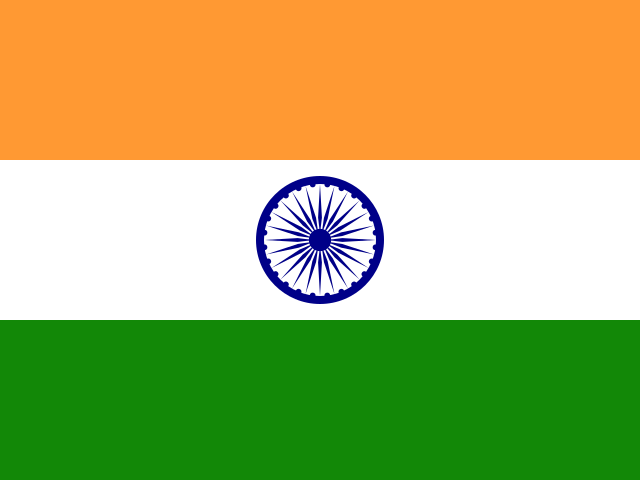
- 🟢 Green: Associated with Islam and used in the Indian flag alongside saffron and white. Nature, growth, and harmony. Broadly positive.
- 🔴 Red: Auspicious and celebratory — the color of weddings, brides, and Durga Puja. Very positive in consumer contexts. High-conversion color for CTAs.
- 🟡 Yellow/gold: Festivity, prosperity, and auspiciousness — particularly strong during Diwali. Widely used in premium and celebration-focused products.
3-2. Recommended Fonts and Sizes: Settings for Optimal Readability
Hindi uses the Devanagari script — a complex Brahmic script requiring dedicated font support. Latin fonts cannot render Devanagari.
"Noto Sans Devanagari" is Google's comprehensive Devanagari font with excellent Unicode coverage and modern design. "Hind" is a purpose-built Hindi/Devanagari font optimized for screen readability at small sizes. Both are available via Google Fonts — use font subsetting to limit file size to the Devanagari Unicode range.
Body text at 16–18px, line-height 1.8–2.0. Devanagari characters include complex conjuncts, vowel marks (matras), and the characteristic headline stroke (shirorekha) — adequate line spacing is critical for readability. Avoid justified text alignment in Hindi, as it creates uneven spacing in complex Devanagari text.
3-3. Layout and Information Density: Design Trends That Resonate
Indian web design preferences reflect a diverse and rapidly evolving digital culture:
- Mobile-first, app-like UI: India's mobile-dominated internet means web design increasingly mimics mobile app patterns — bottom navigation, card-based layouts, and thumb-friendly interaction zones.
- Bold, vibrant visuals: Indian digital design tends toward rich, saturated colors and vibrant imagery — particularly during festive seasons. Minimalist all-white designs can feel cold or incomplete to Indian audiences.
- Trust signals: Indian consumer trust is built through visible trust markers — payment security badges, customer review counts, return policy prominence, and recognizable Indian payment logos (UPI, Paytm, PhonePe).
- EMI/installment prominence: For higher-value purchases, displaying EMI options (No-cost EMI, Easy EMI) prominently is a strong conversion driver in Indian e-commerce.
4. Contact Options and Social Media Integration
4-1. Building Conversion Paths: Contact Options and Social Media Channels
India has a distinctive digital communication ecosystem:
- WhatsApp Business: WhatsApp is India's most widely used messaging platform — with over 500 million users. A WhatsApp Business number with a "Chat on WhatsApp" button is standard for consumer-facing businesses. Many Indian customers prefer WhatsApp over email or phone for initial inquiries.
- UPI payment integration: UPI (Unified Payments Interface) is India's dominant instant payment system — used by over 300 million Indians. Displaying UPI logos (PhonePe, Google Pay, Paytm, BHIM) and enabling UPI payment is essential for any Indian e-commerce or B2C service.
- Phone number (India +91): An Indian phone number builds strong local trust. Toll-free numbers (1800-xxx-xxxx) are associated with established businesses.
- YouTube for brand content: India is YouTube's largest market by users. Hindi-language product videos, tutorials, and brand content on YouTube drive significant organic discovery and trust-building.
4-2. Mobile Optimization: Adapting to a Mobile-First Society
India is one of the world's most mobile-centric internet markets. Over 95% of India's internet users access the web via smartphone — many as their only internet device. The dominant platform is affordable Android (3–6K INR price range).
- Low-end Android performance: Entry-level Android devices with 2GB RAM and slow processors are common. Test site performance on representative low-end devices, not just flagship phones. Google's Lighthouse tool run on a simulated "Moto G4" profile gives a realistic baseline.
- Data sensitivity: Despite cheap data plans (Jio's disruption), many users remain data-conscious. Lazy loading images, compressed assets, and minimal JavaScript are important.
- Hindi input challenges: Typing in Devanagari on mobile is cumbersome for many users — consider enabling Roman-script Hinglish input alternatives in search and form fields.
- Progressive Web App (PWA): For high-engagement services, a PWA that can be "installed" on Android home screens is a high-performing strategy in the Indian market — it offers app-like performance without App Store friction.
5. Summary
Checklist for Building a Successful Hindi Website
- ✔ Are you using a Devanagari-optimized font (Noto Sans Devanagari or Hind) with adequate line-height (1.8–2.0) for complex conjunct characters?
- ✔ Is the full stack (server, database, CMS, URLs) configured for UTF-8 to handle Devanagari Unicode correctly?
- ✔ Have you integrated WhatsApp Business and UPI payment options as primary contact/conversion channels?
- ✔ Does the site load in under 3 seconds on a mid-range Android device on a mobile connection?
- ✔ Are you hosted in AWS Mumbai (ap-south-1) or a comparable India-region data center?
- ✔ Have you reviewed your data collection practices for DPDPA 2023 compliance?
Devanagari rendering, India's mobile-first diversity, and the DPDPA compliance landscape make Hindi websites more technically demanding than they appear from the outside. Leap handles the Devanagari configuration, performance optimization, and compliance infrastructure — so your Hindi website works correctly from the first launch.