


Quick Overview: Cross-Border Ecommerce Costs Depend Heavily on How You Build
How much cross-border ecommerce costs — both upfront and ongoing — depends heavily on whether you sell through a marketplace, build on a SaaS platform like Shopify, or develop a fully custom site. This guide breaks down typical setup and running costs by build method, then covers the breakdown of ongoing costs (fees, ads, logistics, and more) that apply regardless of approach. It closes with a sense of typical outsourcing costs and a worked example using Leap's own pricing.
What Makes Up Cross-Border Ecommerce Costs
It helps to split cross-border ecommerce costs into two categories: setup costs and running costs.
Setup costs
- Building and designing the store, including localization
- Setting up and getting approved for payment methods
- Marketplace deposits or registration fees, where applicable
Running costs
- Platform subscription fees or marketplace selling fees
- Payment processing fees
- Advertising and marketing spend
- Ongoing translation and localization upkeep
- International shipping and customs duties
- Staff time for handling overseas customer inquiries
Which of these ends up dominating your costs depends on the build method, covered next.
Typical Costs by Build Method
Selling Through a Marketplace (Amazon, Tmall Global, etc.)
Selling through a marketplace tends to keep upfront costs low, since you don't need to build your own site — but selling fees become the main ongoing cost.
Per Amazon's own pricing page, Amazon offers two selling plans: Individual, with no monthly fee but a $0.99 charge per item sold, and Professional, at a flat $39.99 per month. On top of that, Amazon charges a category-based referral fee that ranges roughly from 3% to 45% depending on category, though most categories fall in the 8-15% range (as of November 2026, per Amazon's official seller pricing page).
SaaS Platforms (Shopify, etc.)
A SaaS platform like Shopify is built around a monthly subscription plus payment processing fees. Per Shopify's own pricing page, as of November 2026 (annual billing, shown as a monthly rate), the Basic plan runs ¥3,650/month, Grow runs ¥10,100/month, and Advanced runs ¥44,000/month. Online card processing fees through Shopify Payments run 3.55%+¥0 on Basic and 3.4%+¥0 on Grow (rates vary by card brand). Separately, if you hire an outside agency to design and localize your store, industry blog estimates put template-based builds at several hundred thousand to around ¥1.5 million, with fully custom builds running ¥2 million or more — though these figures come from individual agencies, so it's worth getting your own quote.
Fully Custom Development
Building a cross-border site entirely from scratch offers the most flexibility, but setup costs can reach tens of millions of yen, and multiple industry sources put ongoing maintenance and operations alone at around ¥500,000-¥1,000,000 per month. This path tends to suit larger-scale operations.
Typical Costs of Outsourcing or Using an Agency
Hiring separate agencies for site-building, localization, marketing, email campaigns, and day-to-day store operations can add up to an estimated total of over ¥1,000,000 per month (per Leap's own sales materials, based on typical outsourcing and agency rates). Agencies that manage cross-border operations for you often charge a flat monthly fee plus a performance-based fee, so it's worth asking for a breakdown of both fixed and variable costs when you get a quote.
A Worked Example Using Leap's Pricing
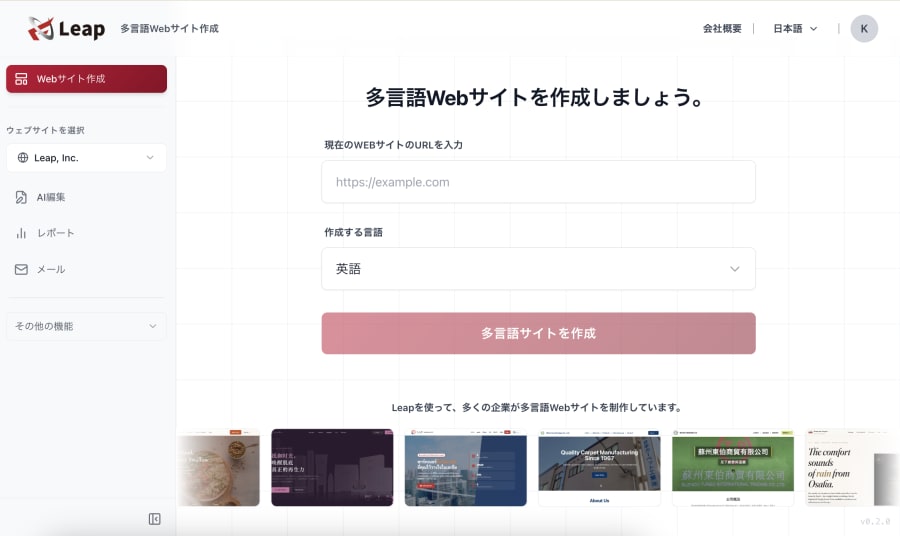
As one way to get a feel for real-world costs, here's a worked example using Leap's own pricing (as of November 2026, before tax). Leap offers a Starter plan at ¥9,800/month and a Basic plan at ¥39,000/month, among others, plus a flat 6% fee on cross-border sales that already includes payment processing. If you're on the Starter plan and selling ¥1,000,000/month overseas, that works out to roughly ¥9,800 in subscription fees plus ¥60,000 in fees, for a total of about ¥69,800/month — around 7% of monthly sales. That percentage shrinks as sales grow, since the subscription fee is fixed. This is just one example; actual costs vary by product, shipping method, and destination country, so check the official pricing page for current plan details before committing.
FAQ
Q. Can I start cross-border ecommerce with no upfront cost?
A. It depends on your build method. Selling through a marketplace or a SaaS platform tends to require less upfront investment than building a custom site from scratch. That said, payment method approval and translation/localization work often come with their own separate costs.
Q. What's a typical monthly budget for running a cross-border store?
A. It varies widely by build method and scale. Marketplace selling is dominated by selling fees (roughly a few percent to the mid-teens, depending on category). SaaS platforms are dominated by subscription fees plus payment processing. Fully custom builds can run ¥500,000/month or more just for maintenance, per several industry estimates.
Q. Is it cheaper to sell on a marketplace or build your own store?
A. Marketplaces tend to have lower upfront costs. But because marketplace selling fees scale with revenue, a self-built store can become the cheaper option as sales volume grows. Which makes sense for you depends on your product and sales volume.
Q. How much does an agency charge to run cross-border operations for me?
A. It varies by agency — some charge a flat monthly fee, others add performance-based fees on top. Costs tend to add up quickly if you're hiring separate vendors for each function (site, marketing, logistics, and so on).
Summary and Key Takeaway
Cross-border ecommerce costs break down very differently depending on how you build: marketplaces keep upfront costs low but carry ongoing selling fees, while custom builds demand more flexibility, more money, and more ongoing maintenance. Rather than fixating on any single number, it's worth running your own cost comparison against your expected sales volume and growth trajectory to see which setup actually pays off.
Leap is a cross-border ecommerce tool that lets AI handle marketing too. Just chat with it to build a multilingual, multi-currency online store and run overseas marketing such as SEO and email newsletters.